
“There will always be misconceptions, because we are fallible and lack knowledge, but discovering and correcting one’s mistakes can be an endless source of interest and fun!”
– Sarah Fitz-Claridge
This is a transcript of an eponymous talk, a shortened version of which I gave in Oxford at the critical rationalist conference, Conjecture Con Europe, on 16th May 2026. [video]
Many of the misconceptions parents have about Taking Children Seriously, they have as a result of things I myself have said. For example, my intention, in answering the FAQ question “What is Taking Children Seriously?”, was just to give a broad brush strokes idea of what the Taking Children Seriously website is talking about, but my harsh, essentialist-sounding wording and lack of explanation has caused so many misunderstandings that it needs a rewrite.
Let’s look at some more misconceptions I have caused. And as always, listen [or read] critically, and question everything!
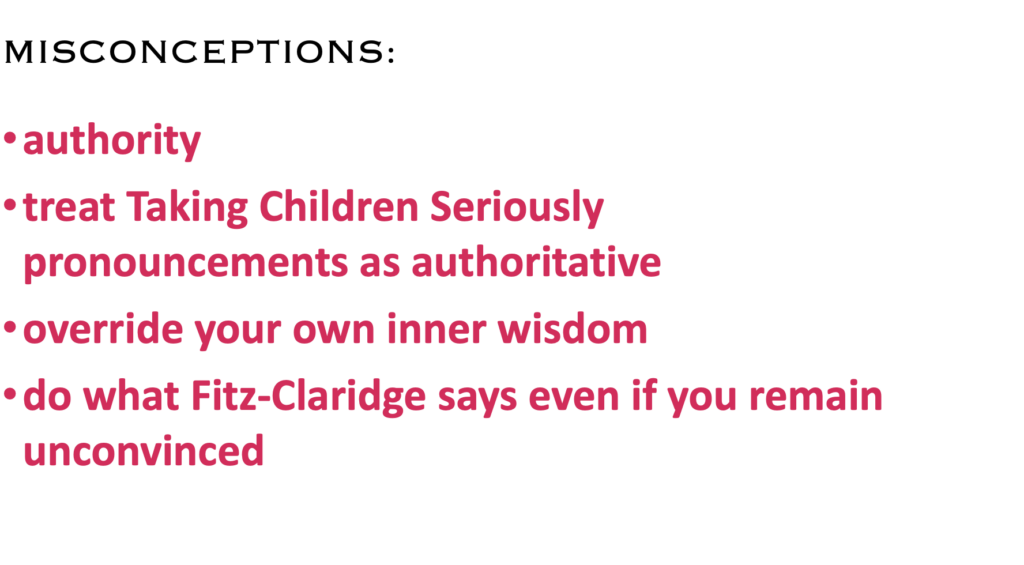
Some lovely parents are so keen to take their children seriously, that when they hear me banging on about bedtime, or being scathing about school, they sometimes self-coercively override their inner wisdom in favour of doing what they think I think they should be doing. As if I were an infallible authority. As if there were such a thing as authoritative knowledge.
So I often stress that: irrespective of age, people should do what they think right, not what someone else thinks right.
When I say that, some parents hear:
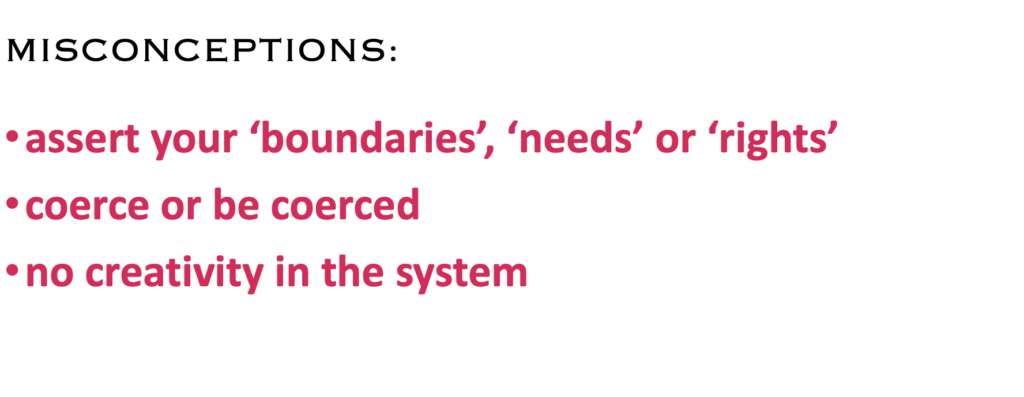
“In the event of a disagreement, assert your ‘boundary’. Stand on your rights. Your needs are sacrosanct. The kids don’t get to dictate how you use your time or money. There’s either asserting your boundary, or there’s being enslaved. It’s a zero-sum game. Coerce the child.”
But the idea of asserting ‘boundaries’ mistakenly assumes that there’s no creativity in the decision-making system.
We are not stuck with choosing between coerce or be coerced. Disagreements are resolvable. People are creative! Problems are soluble!
‘Boundaries’ and ‘needs’ are wishes. Wishes are important, but they do not have any special status putting them beyond reason. Parents sometimes talk about “my boundaries” or “my needs” to immunise their wishes from their children’s criticism, turning their wishes into non-negotiables—blocks against problem-solving.
One father talked about his need for the kitchen to be clean and the table to be cleared of the breakfast things. I can relate. In my zeal to keep things clean, I am constantly going around collecting things and putting them in the dishwasher (sometimes prematurely!). Except that in the father’s case, instead of meeting his need himself, he appealed to that ‘need’ to pressure his children into clearing the table and cleaning the kitchen for him. Well it’s a need! Who could argue with a need?
Another parent talked about how it is her right to refuse to spend her time and money on things she is not comfortable with. She said “It’s my personal boundary.” She was appealing to boundaries and property rights to justify blocking the resolving of a disagreement with her child.
Although the word “boundaries” can refer to many good things (such as good boundaries in the psychological sense, or wishes for one’s own body and life that should be respected), the trouble is, in the context of parents and children, it usually indicates a coercive stance on the parent’s part. Parents equivocate when using the term, appealing to the unobjectionable meanings of the word to justify imposing coercive boundaries against their children—coercive blocks against resolving disagreements.
A disagreement is a problem to solve. A genuine solution is one both parties wholeheartedly prefer, with no hankering for a different outcome. We are looking for a new idea to solve the problem, we are not choosing between the ideas in dispute. Taking someone seriously does not mean going along with them despite still disagreeing. The solution will seem better to you than the ‘boundary’ you would have asserted. And it will seem better to them than their initial wish too.
What often makes resolving a disagreement seem impossible is all our preconceptions about what the solution must look like. Like the father with the need for the clean kitchen who was feeling entitled to his children’s help in solving his own problem.
It is fun and interesting to question everything, including all those preconceived bottom lines.
What are our respective reasons for wanting what we each want? Getting a wider perspective on the problem often makes a difference.
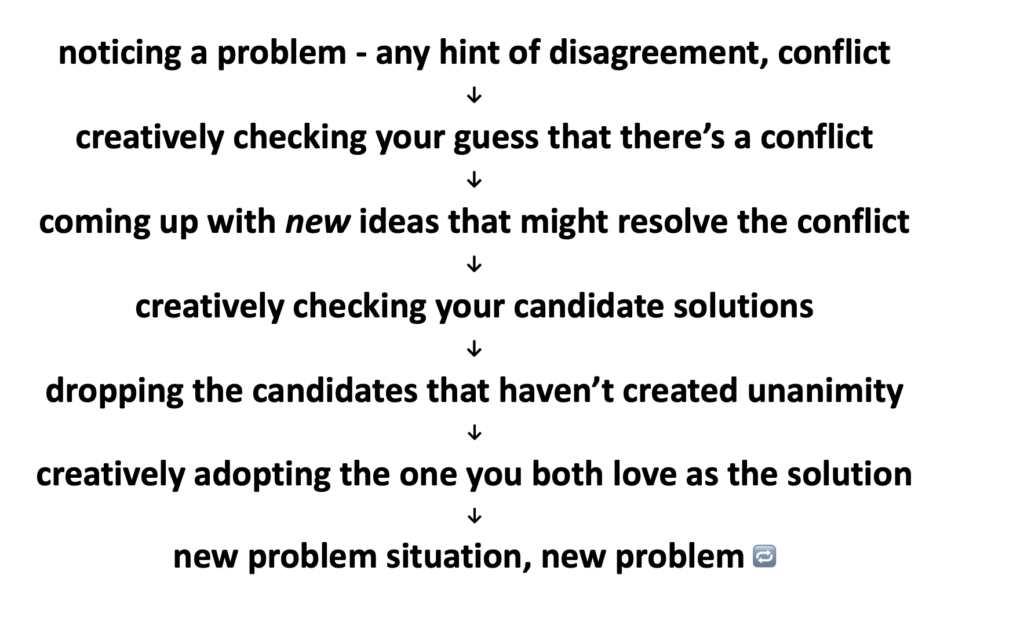
Resolving a conflict involves creativity and criticism: bold new explanatory guesses—candidate solutions that we criticise to weed out the duds, until a creative solution emerges—one we both love. When you have gone from disagreement to wholehearted agreement, there is no longer an obvious problem to solve.
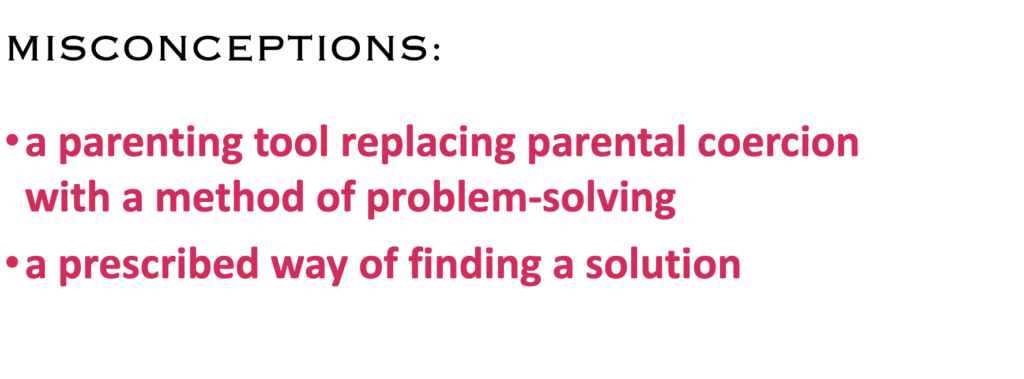
If I make the mistake of mentioning the epistemological logic, that leads to the misconception that Taking Children Seriously is a parenting tool replacing parental coercion with a method of problem-solving.
And that to resolve a disagreement you have to have a discussion in which you follow the supposed ‘problem-solving steps’ of the supposed ‘Taking Children Seriously process’.
And then parents complain that their children seem strangely reluctant to ‘follow the problem-solving steps’ with them.
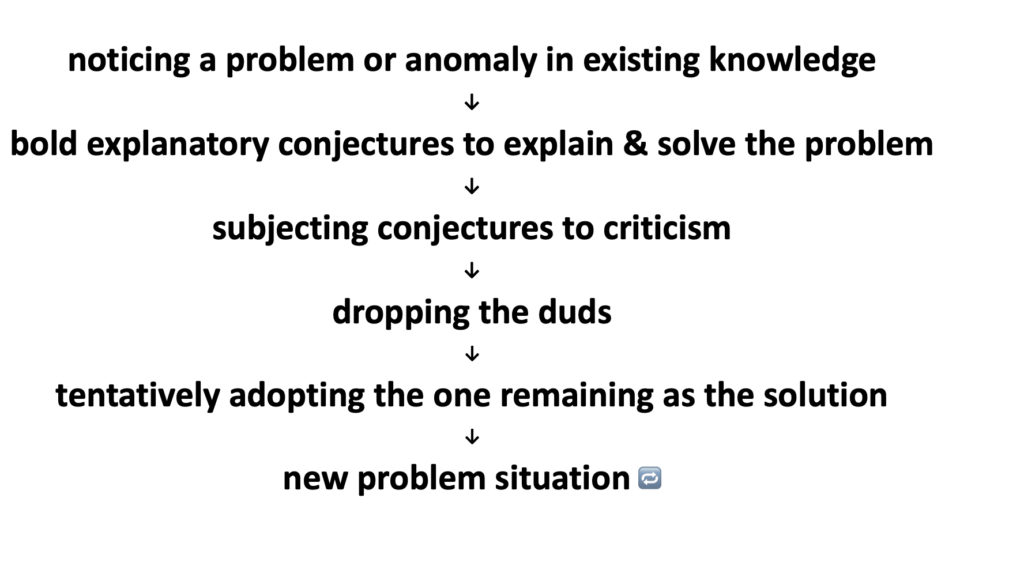
Popper’s epistemology describes the logic by which knowledge is created. It is not a recipe.
Most of the problem-solving we do, we do inexplicitly, and unconsciously, not through explicit thought, let alone explicit discussion.
To resolve conflicts we should assume that disagreements are actual problems, actual ideas being in conflict, and that there is a solution, and that everybody will be better off if we find a solution—not that there is a prescribed way of finding the solution.
That could be different in every family and indeed different in different circumstances.
When Taking Children Seriously is misunderstood to be having a discussion to reach unanimity, or it is misunderstood as prescribing such discussions, this causes all sorts of trouble.
- How can babies have a discussion? Yet it is definitely possible to take their wishes seriously! See the video of Vivek interacting with a five-month-old pre-verbal baby.
- It has parents imagining that there is nothing to do until there is a disagreement. Whereas in fact Taking Children Seriously involves an ongoing flow of information and knowledge between the family members. Where is the ongoing curiosity and wonder and generous-heartedly playfully experimenting to make life even better both for you and your loved ones on a moment-by-moment basis, as well as thinking deeply about what makes their heart sing, their likes and dislikes, their sensitivities and places where they might appreciate gentleness, and so on? Where is the theory-sharing at a much much earlier point in the proceedings, long before the family heirloom is about to end up in the lavatory? See: Think flow.
- It has parents not realising that they themselves can head off many problems by coming up with creative solutions in their own mind, using their deep knowledge of their loved ones, without necessarily talking with the loved one in every case.
- When parents fail to realise that most problem-solving happens inexplicitly or unconsciously, rather than through explicit thought or discussion, they often make the rationalist mistake, of fetishising the explicit, and ignoring, or not taking into account, everything else. See: The rationalist mistake.
- It has parents coercing their children to ‘find solutions’:
“We have regular family discussions to hash out solutions, but sometimes I have to insist that they have the discussion.”
“I have two areas of concern at this point. The first seems ironic—I want to force my children to find consensual solutions (‘you can’t watch a movie until both of you agree on which one’).”
Bringing coercion into it by trying to get your child to engage in what you mistakenly think is a problem-solving process, is just creating another conflict and entrenching it. It is not solving anything.
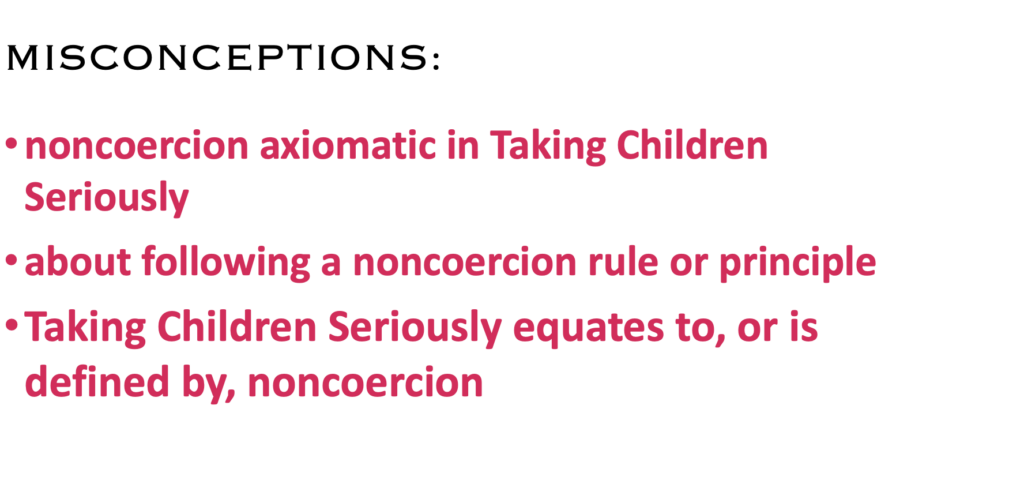
When I mention noncoercion, that leads to another misconception: that noncoercion is axiomatic in Taking Children Seriously; that Taking Children Seriously is about following a noncoercion rule or principle; that Taking Children Seriously equates to, or is defined by, noncoercion.
And then parents ask questions like “Surely it’s coercive to grab your kid out of the path of an oncoming car?!” as if noncoercion is The Point—an end in itself.
Noncoercion is not an end in itself. It is merely a necessary condition for resolving disagreement into genuine agreement. Not a sufficient condition, but a necessary one.
Treating your ‘boundaries’ as authoritative, and using your greater strength and power to impose your will, may force your preferred outcome, but it is not happy unanimity.
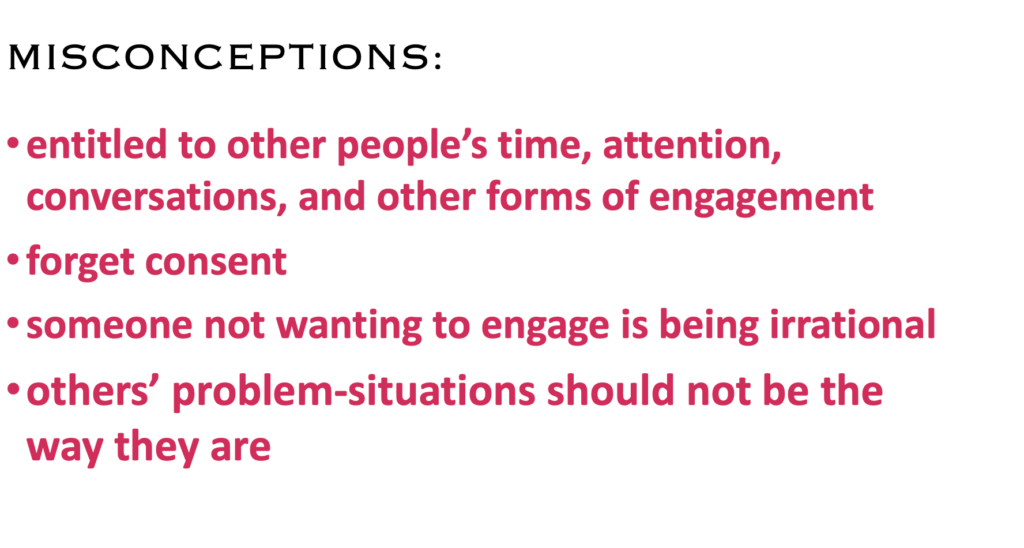
When I talk about solving problems in ways both parties prefer, some people get the impression that I concur with their feeling of entitlement to other people’s time, attention, conversations, and other forms of engagement. They think I am saying that when someone does not want to engage with them, that person is being irrational. Somehow, such people forget all about consent and respecting other people’s wishes for their own bodies and lives. They forget that another person is not them. That other person’s problem situation (the person’s unique interests, concerns, problems, and so on in a given moment) is not theirs, and other people have to do what they themselves think right, given their own problem situation in that moment, not what you or anyone else thinks they should be doing.
To some, that sounds like “assert your boundaries against your children” again. But it is not. Our children are not mere strangers or acquaintances with whom we have no particular relationship, they and their wishes matter hugely to us. We are sharing our lives with them. When an arms’ length acquaintance, a casual date, or a stranger on the internet wants something, you might not feel inclined to go out of your way to accommodate them. But when someone you are in a relationship with wants something, you want them to have what they want. You experience their problems as your problems. Moreover, we have chosen to bring our children into our lives, raising obligations towards them. It is not that we wake up each morning feeling coercively burdened by the obligations we have raised towards our children. It is that the obligations we have created—our children’s property rights to our care—inform and condition what we want.
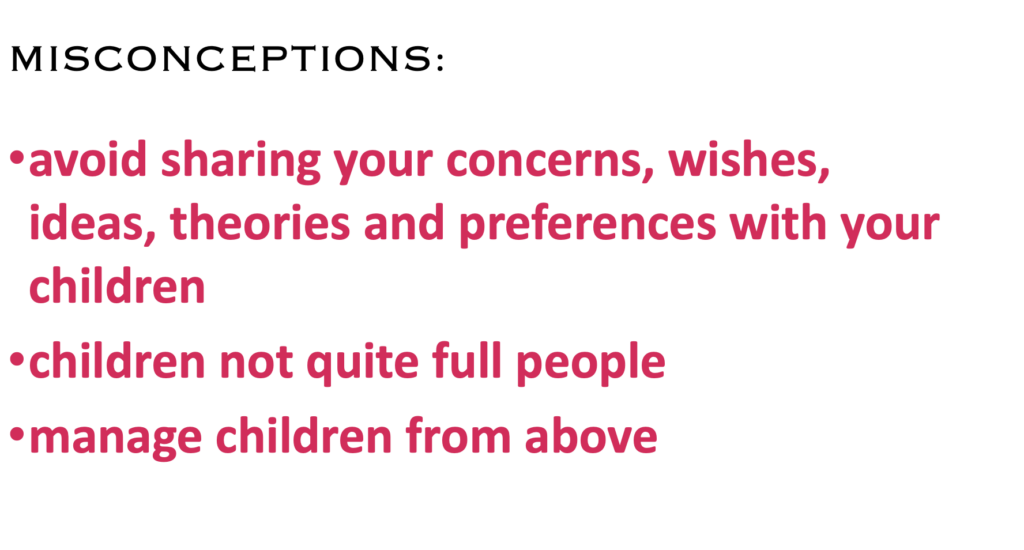
Another misconception I inadvertently create when I speak about noncoercion is that you should avoid sharing your concerns, theories, ideas, wishes and preferences with your children, lest they burden or coerce the children.
Whilst yes, that is possible, and we have to try to share our wishes in noncoercive ways (let’s not assert them as ‘boundaries’ or ‘needs’ or ‘rights’ for a start), it is a mistake to have a policy of hiding our wishes and preferences from our children. If our children do not know what our wishes are, how can they possibly take them into account? In keeping your wishes hidden, you are depriving the decision-making system of the vital knowledge of your wishes. The system needs all the wishes to be on the table to resolve the conflicting wishes creatively.
Some parents think they should not share their theories with their children because they think Taking Children Seriously means children navigating life without help from parents! Nooooo.
Others think that Taking Children Seriously means not mediating children’s relationship with things—as if saying anything is coercive, so say nothing. But there is a better option: noncoercive communication.
Or it might be that it just does not occur to you to talk to your children like you would talk to me or your partner. As if the children are not quite full people? For example, a lovely father who is a professional chess player consulted me about a dilemma he had: he wondered if he was lying to his child by letting his child win. I suggested (as I so often do!) that he consult the child, laying out his dilemma to the child exactly the way he had to me, to find out what the child would actually prefer (and the child might have different preferences at different times), and what the child’s reason for wanting to play was. (The actual reason surprised the father: the child enjoys spending time with the lovely father, and had no particular interest in chess otherwise, and was aware that the father was not playing to win and appreciated it.)
Parents are so often (and so tragically) surprised when, following my suggestion to lay out their concerns and dilemmas to their children just the way they have done to me, and they do so, that they have amazing conversations with their children. Or that their children turn out to be very interesting, thoughtful people with brilliant ideas, not people needing to be managed from above.
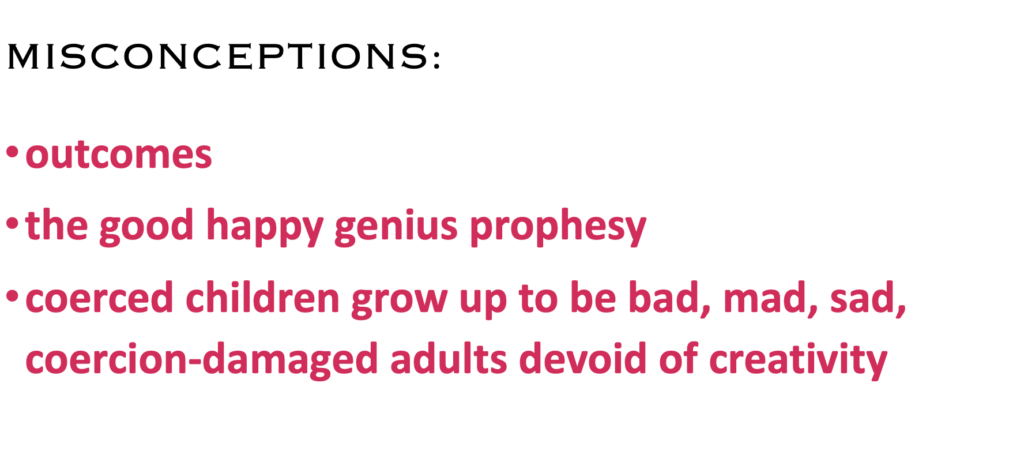
Some parents think I am saying:
“In the absence of coercion, your children are guaranteed to grow up to be good happy geniuses.”
The good happy genius prophesy.
Future knowledge is unknowable.
It cannot be predicted, let alone guaranteed.
Taking Children Seriously might even reduce the possibility that the children become geniuses: it is not inconceivable that genius might be the result of a child self-protectively withdrawing into a narrow sphere of life as a coping strategy in the face of coercion.
There is a lot of luck involved. Sometimes a childhood could be in some sense good, and yet the person ends up far from a good happy genius. The outcomes are not predictable. And thinking in terms of outcomes is morally questionable. If you’re ‘taking children seriously’ to engineer an outcome, perhaps you’re viewing the children as products not people. The child-as-product idea forces children to live as if their life won’t start until someday. For the sake of a supposed someday, we ruin their actual life now.
People have rights, and they are self-owning. They are not products. They are not a means to our ends, they have their own ends. I think that having rights and being self-owning is good for you. But in a particular case it might not be: somebody might voluntarily choose to join the military and be killed. (OTOH, whether that is good for them is not really meaningful: if they have led the life they want to, that is the object of the exercise.)
Others think I am saying that if your children do not grow up to be good happy geniuses, it is your fault, and nothing would have gone wrong if you had followed the ‘Taking Children Seriously prescription’—as if Taking Children Seriously were an authoritarian, utopian idea like many ‘parenting ideas’, instead of an evolving set of conjectural solutions to the problem of children being hurt, creativity and growth of knowledge being impeded, children being arbitrarily excluded from the normal values people have about how to treat others, and so on.
Some think I am saying: “If you coerce your children, they will grow up to be bad, mad, sad, coercion-damaged adults devoid of creativity.”
Again, no one has any idea what future results will be. People have such creative brilliance that they often manage to create their way out of dire circumstances, into a great life flowing with creativity.
When people think in terms of outcomes, it is tempting to talk about how brilliant your children are. This violates their privacy, and even if they think they don’t mind now, there have been cases in which the children have come to mind very much later on, so I think it is unwise to risk it even if they say they do not mind. But even apart from the privacy issue and the possibility that they might later come to regret having been talked about, there is also the mistake of setting yourself and your family up as a Taking Children Seriously poster family. That invites public scrutiny, which can make you and your family feel self-conscious and may turn your lives into a performance, risking destroying your authentic creative relating and living.
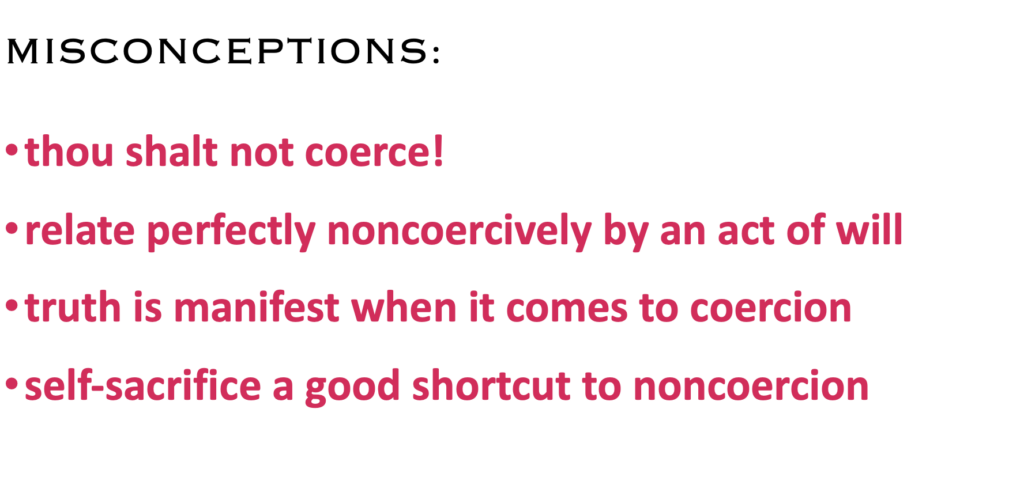
Some see Taking Children Seriously as a frowny “Thou shalt not coerce!” prohibition.
As if it were obvious how not to coerce.
Some hear: “If you fail to resolve every conflict creatively you are wilfully wicked.”
As if the truth of how to resolve every conflict is obvious, and it is just a case of doing that thing.
That is complete rubbish! It is not obvious! And we do not know what to do!
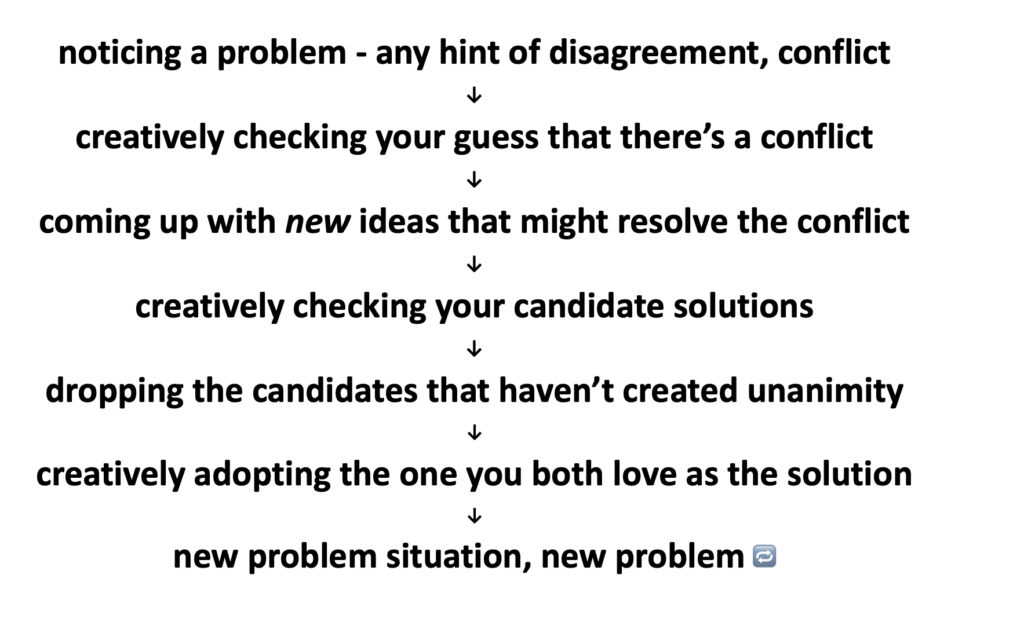
There is no way to not coerce by an act of will. It involves the creation of knowledge.
If you just look at the epistemological logic, that might look simple and straightforward.
You have noticed that there is a disagreement to resolve—a problem to solve.
You are coming up with possible solutions.
You are criticising your conjectures to try to discover which if any stand up to your critical scrutiny.
You are dropping those which do not.
And you are tentatively adopting the one left standing, as the solution.
New problem situation.
New problem.
It all sounds simple, but it is not. Creativity is involved throughout.
Identifying the problem in the first place involves creating new knowledge—conjectures and refutations, as it were.
Criticising your conjectures involves creating new knowledge.
It all involves creating new knowledge.
And your knowledge of the problem is evolving throughout. Your knowledge of all of it is evolving throughout.
There is nothing remotely obvious about any of this, and none of it is something you can just command yourself to do by an act of will.
Truth is not manifest when it comes to coercion and how to resolve a conflict creatively instead of coercively. I have been thinking deeply about this stuff for over half a century, and I am still discovering mistakes including coercion-related ones. One’s knowledge never stops evolving.
The idea that it is possible to relate perfectly noncoercively by an act of will, leads parents to fall into a pattern of self-sacrifice. And then everything goes wrong.
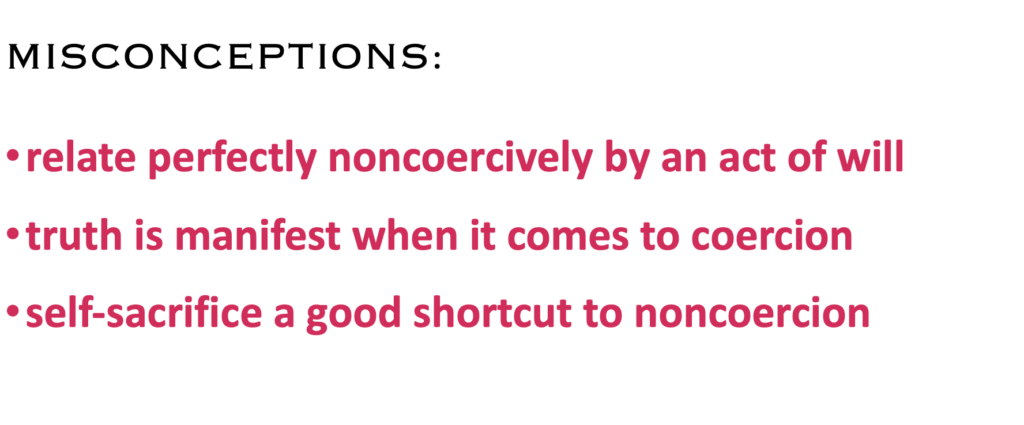
Self-sacrifice is not resolving the conflict, it is coercing yourself.
Coercion anywhere in the decision-making system blocks creative conflict resolution, not just coercion of the child.
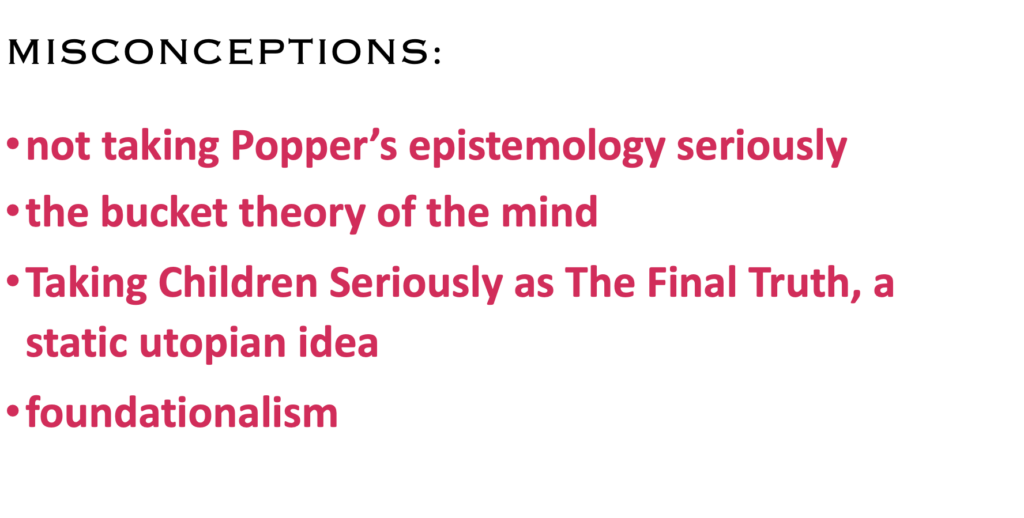
Some misconceptions critical rationalists have about Taking Children Seriously are, I conjecture, misconceptions about Karl Popper’s epistemology.
Some are operating as if the mind is a bucket, or as if not all knowledge is conjectural.
One accused me of suggesting that Taking Children Seriously is The Final Truth: a static utopian idea resting on a solid foundation.
Another critical rationalist is home educating her children because: “the schools don’t teach Popper’s epistemology.” (They’re too busy instilling conformity.)
She said: “I want my children to have a solid foundation in the epistemology.”
That foundationalist language reminds me of Popper’s evocative metaphor in The Logic of Scientific Discovery, that so beautifully expresses the idea that knowledge is conjectural—that there is no foundation. He was talking about science, but his epistemology is inherently universal, so if it is true, it is true of all knowledge, including the epistemology.
“Science does not rest upon solid bedrock. The bold structure of its theories rises, as it were, above a swamp. It is like a building erected on piles. The piles are driven down from above into the swamp, but not down to any natural or ‘given’ base; and if we stop driving the piles deeper, it is not because we have reached firm ground. We simply stop when we are satisfied that the piles are firm enough to carry the structure, at least for the time being.”
– Karl Popper, 1959, The Logic of Scientific Discovery, Part 5, Chapter 30, p. 94
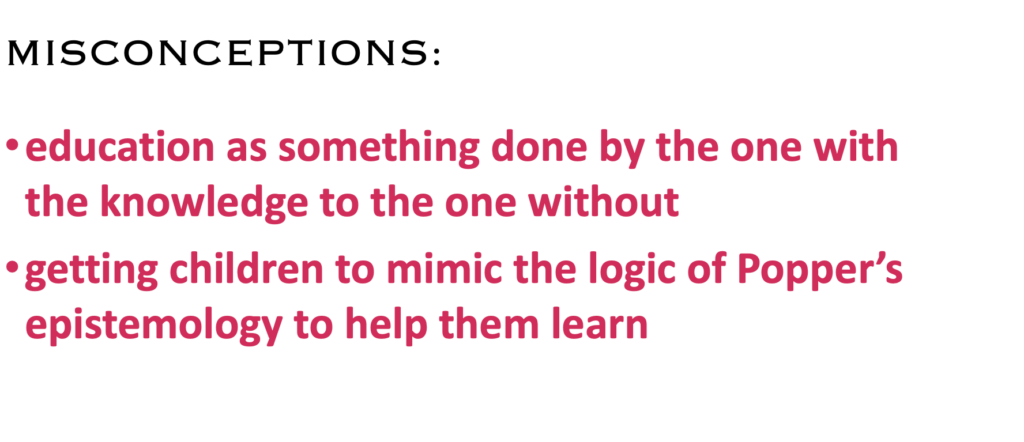
The Popperian homeschooler said:
“I’m teaching my children that knowledge is conjectural—creative guesses. Whenever one of them asks a question, I remind them that knowledge is just guesses and get them to start guessing the answer. And I have them criticise their guesses.”
She is not giving them “unwanted answers to unasked questions”. But she is requiring them to give her answers—giving them ‘educational’ hoops to jump through.
As if education is something done by the one who already has the knowledge—to the one who does not.
In reality, it is the other way round: the one without the knowledge is the one actively pursuing the knowledge, and we are following that lead by answering their burning question.
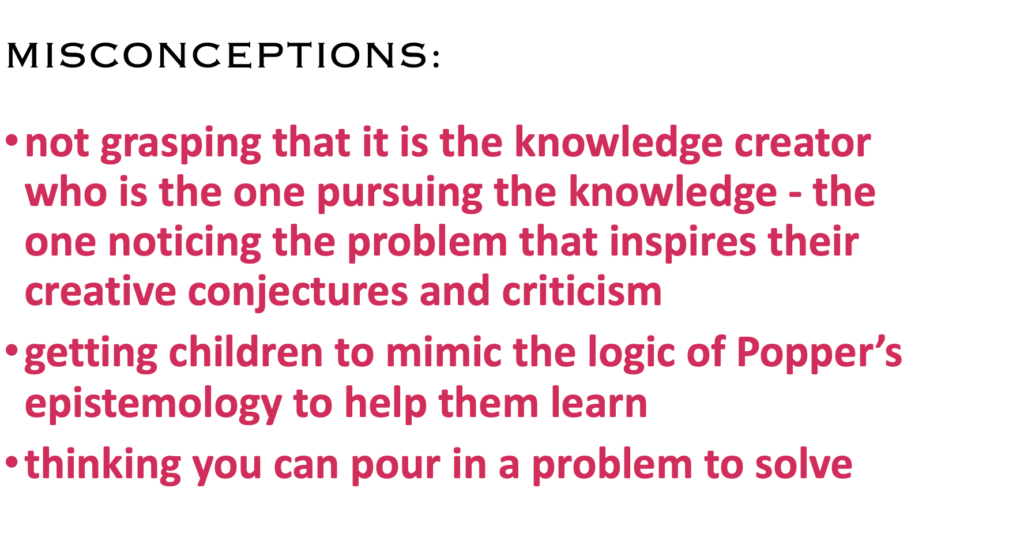
Channelling children into your educational agenda for them is bucket theory of the mind territory—even if what you are trying to pour in is the idea that knowledge is creative guesses, and that knowledge cannot be poured in.
Getting children to guess and criticise may look like the form of the epistemological logic, but it is not taking the epistemology seriously.
What gives rise to the conjecturing in the mind of the learner?
A problem in the mind of the learner.
Something surprising to them. Something interesting that ignites their creative thought given their unique problem-situation in that unique moment.
What is that something?
The child clearly has a burning wish to understand whatever they are asking about, or they would not be asking you about it.
But instead of immediately answering their burning question, you are withholding the answer while you subject the child to a pedagogical exercise to further your educational agenda for the child—that they learn that knowledge is guesses.
That is not what their question was about.
You are diverting them from the problem they wanted to be solving, to solving a different problem: such as how to jump through your ‘educational’ hoops, while attempting not to lose the train of creative thought they were engaged in.
When we do this kind of thing to children, it is as if we are unaware that they are already busy pursuing the growth of knowledge—as if we imagine their minds to be buckets, just waiting passively for us to pour in the knowledge we think needs to go in there.
But their minds are not buckets, they are actively pursuing knowledge, and our educational agenda is impeding their actual learning.
If learning that knowledge is guesses is important, that raises the question how do people learn?
If Popper’s epistemology is true, you do not learn the epistemology by performing a set of steps mimicking the epistemological logic, you learn it through your own creative guesses and criticism, inspired and driven by your own curiosity.
You cannot pour a knowledge-creating process into a mind.
This misconception is not limited to parents.
Some academic educational researchers bring what they see as a ‘Popperian protocol’ into the school classroom. Not classes in the epistemology like the critical rationalist home educator wanted, but designing lessons around ‘problem-based learning’.
The teacher presents a problem.
The teacher gets the children to conjecture candidate solutions, criticise them, weed out the duds, and so on. Unlike in standard teaching, in the ‘Popperian protocol’, making mistakes is not penalised.
The children conjecture candidate solutions, criticise them, weed out the duds, and so on.
The researchers are viewing the children as subjects in their research, instead of seeing the children as knowledge-creators themselves.
The logic of Popper’s epistemology means that you cannot pour a problem into a mind. A problem is a piece of knowledge created inside the mind of the knowledge creator.
It is the knowledge-creator herself who notices the problem that sparks the creative conjectures and criticism.
That noticing happens inside her mind, never by instruction from outside.
The ‘Popperian protocol’ teacher may think that the problem she has set her class to solve is the one the students are solving, but what they are actually solving is something like: how do I perform a convincing enough semblance of conjectures and criticism to avoid a detention, when what I really want to be doing is vibe-coding at home, or learning chemistry from The Anarchists’ Cookbook.
Popper’s epistemology is inherently universal. If true, it is true in all realms of knowledge, for all types of knowledge: whether new to humanity, or just new to the individual, whether explicit or inexplicit.
Learning is inherently unpredictable. You cannot design and plan a knowledge-creating process in advance. The learner’s problem-situation evolves, and there is no method. It is new, and different, and evolving, for each person, in each circumstance, in each moment.
When you try to channel your children into your educational agenda, you are thinking of education as being something you direct and do to the child, instead of realising that you have it backwards.
Parents sometimes ask questions like: “If a child must create a conjecture before they can truly learn, does that make instruction impossible without consent?”. Such questions suggest the wrong theory of mind. Saying “impossible without consent” is still assuming the bucket theory of the mind, instead of understanding that there is no such thing as instruction in the pouring in sense, and that the knowledge creator is the one noticing the problem and conjecturing, and so on. It is not just about consenting to be taught. That still misses everything. Instruction does not do what it purports to do. It cannot pour anything in.
What is happening in your driving lesson is that you are guessing how to drive the car, and using the driving instructor to check your guesses.
So, consent is one thing. How learning from another person works is a different thing. And it does not work by instruction, even if the parties wanted it to.
Another misconception is that Taking Children Seriously is consistent with retaining parental authority. That causes all sorts of trouble.
Sometimes parents are unaware that they are still viewing their children through the lens of paternalism, so here are some examples of statements and questions that indicate that they are viewing themselves as the authority over their children:
“I let my kid eat what she likes. So far it’s working well. She’s not eating too much junk food and she’s within normal weight.” (“I let my wife eat what she likes. So far it’s working well. She’s not eating too much junk food and she’s within normal weight.”)
“We’re in the process of transitioning our family from rules to no rules.” (The parents as managers and directors. Also Taking Children Seriously is not merely “no rules”—but we will get to that later.)
“How can I get my kids to do their homework/hand over their devices at bedtime/get up in time for nursery school without coercion?” (The parent has an agenda, a preconception about what must happen, and is asking how to channel the child into that agenda.)
When parents ask questions like, “How can I get my child to hand over her iPad at bedtime without coercion?”, I often point out that that is like a husband asking “How can I get my wife to hand over her iPad at bedtime without coercion?”
If it seems glaringly inappropriate to ask the question about an adult, that is a clue that it might be problematic with respect to a child too. Making such a check can help reveal vestiges of the old paternalistic view of children hiding in our thinking.
When I say such things, some parents get the misconception that I am also saying that if you would say or do something in a case with an adult, that is a good indication that saying or doing that with your child would be reasonable too. One parent even called it a litmus test of noncoercion and taking the child seriously. That is a mistake.
Even if we assume the best about how you treat your adult loved ones—that you have a commitment to figuring it out with them, and thus engage creatively with them—let alone if you have not created creative relationships with them—the fact that you would say or do such-and-such with that adult loved one in no way rules out it being coercive to say or do that to your child.
It is zero guide to the right thing to do or say with a child, because our children are in the position they are in because of our choices not theirs, so we have raised obligations to our children that they do not have to us, and that we do not have to other adults, even adult loved ones, and it is a mistake to be pretending not to have those extra obligations towards our children (and thus a commitment to figuring it out) with our children.
The point of asking yourself if saying or doing such-and-such would be appropriate were it an adult instead of a child, is only to look for possible paternalism; it is not to rule out coercion. And it is not a definitive test, it is just a quick way of sometimes revealing a blind spot.
If you still have the conventional paternalistic view of children, then when there is a dispute between your children, you might think that either you have to assign blame and force the ‘right’ outcome like many parents do, OR, “STAY OUT OF IT”. (As if your only options are ‘Judge, jury and executioner’ or ‘potted plant’.)
Having a policy of ‘non-intervention’ amounts to denying the children the benefit of your own ideas and your own creativity and help in resolving the dispute.
To the extent we can assist them in resolving conflicts with one another, such as by helping each get a wider perspective on the conflict, viewing one another more favourably, we should.
When there is a dispute, there is a lack of creativity. When parties are fighting, most of their creativity is focused upon how to defend their position and win the fight.
In such frames of mind, the parties are highly unlikely to be able to create a real solution. So what is called for is something that helps them stop thinking about winning the fight and start applying creativity to the problem. It is their own thinking that is likely to be most important, but that does not mean that you should not assist to the best of your ability.
Parents sometimes think that if they intervene creatively, that somehow interferes with the children learning to resolve disputes themselves, but such thinking is a hangover from conventional thinking about education. Like the parent subjecting her children to a pedagogical exercise to further her educational agenda for them that they should learn Popper’s epistemology, parents choosing to ‘STAY OUT OF IT’ to avoid interfering with the children learning to resolve disputes by themselves, are imposing that educational agenda on their children. Parents often refuse to help their children when their children want their help, to help them learn to do whatever it is by themselves. That is coercive education, not taking children seriously.
I am not suggesting doling out advice from on high, I am suggesting human-to-human bringing them together with your own creativity that is online because you yourself are not a party to the dispute. We bring our creativity to bear to bring genuine creative resolution and restore harmony between arguing others, just like I at least would do if it were my two beloved sisters having a dispute.
What matters is resolving the conflict by any means available. We should help whenever we can, unless they do not want us to.
If instead of adding more coercion to the situation, you start giving them ideas about how to resolve the dispute, that may be just what is needed to help them out of their destructive defensive positions and into frames of mind in which creativity flows and the problem can be solved. Sometimes it does not even have to involve explicit suggestions. Sometimes, I bring empathy and show each their own love and affinity for the other, just by a few empathetic sounds with evident love for both.
We are so much more creatively brilliant than we imagine. We can all make a difference for other people, in their disputes with others. And we can do this even if we do not even know the person with whom our friend or family member is having a dispute, and even if we have no contact with the other person we do not know. Let alone if the two parties are our beloved children right here with us! Never think that you cannot make a difference in others-to-others disputes. You can. And just think how making such a difference can ripple outward, as the parties then are each in a better frame of mind, each more likely to be kind to others in their lives, who themselves then feel more kind towards others, as so on, in a ripple of transformative creativity touching more and more people.
Another misconception: Taking Children Seriously as just a matter of not having rules for children. I do not think many British parents have rules for their children, but they are still not taking children seriously. Many parents do not have rules.
Imagine you are a husband, and despite the fact that you are no longer imposing and enforcing rules on your wife, she is still acting as if you are still coercively controlling her like you were before.
You are very puzzled. Whenever she wants to do something you think unwise, you do let her. Instead of forcing your preferred outcome, you have a talk with her, to find a solution you both prefer.
Except that sometimes she is not open to criticism and seems not to want to find a solution.
In fact, now that you are letting her do what she wants, and no longer forcing her to do the important things but trying to make doing the important things more fun for her, she seems to be misbehaving worse than ever. Relaxing your control seems to have made things much worse with her, not better.
Maybe the sudden loss of the structure the rules provided is making her feel insecure? Maybe that is why she is acting out? Maybe what you should have done was to drop your rules incrementally, one at a time, or to have just one rule-free day a week at first, and be willing to backtrack if the new freedom you are giving your wife seems to be resulting in untoward behaviour?
Taking Children Seriously is not just not having rules for your children. That can be done mechanically. Taking Children Seriously involves creativity. We are building vibrantly creative relationships together. Where is the creativity in that husband’s approach? The husband has not even dropped the idea that he is in charge. He is still thinking about he should manage his wife, even after dropping his rules. He is still not viewing her as a full person. He still thinks that if he does not like the way his wife reacts to her newfound ‘freedom’, that would justify him not taking her seriously, and reimposing rules on her. That would be like someone in the time of slavery justifying not ending slavery, or reintroducing it, if the slaves’ behaviour became disagreeable once they were freed.
When Popperians become interested in Taking Children Seriously, some start thinking about Popper’s theory of politics.
Popper warned against utopianism, urging piecemeal changes in society instead of revolutionary ones.
So some Popperians conclude that they should not suddenly drop all their family rules. They should make piecemeal changes instead: drop one rule; see what happens; reinstate it if something bad happens.
But that is drawing too close an analogy from Popper’s theory of politics.
In politics evolutionary change does involve repealing one law at a time, and then solving the resulting problems, which sometimes might involve backtracking; then repealing another law, and so on. You have no choice but to do that in the political arena.
For Popper, the fundamental problem in politics is how to avoid violence. But in a family, that is easy, and that is not the core of the problem.
The core of the problem in a family is how to allow happiness and knowledge to evolve, and not hurt each other, not just physically, with violence, but not to hurt each other at all.
And that is an open-ended problem, but it is not solved by just avoiding violence. And it is not solved by just avoiding rules either. Let alone by removing rules piecemeal.
Applying Popper’s politics to family life is a bit like applying libertarian property rights theory to it, and then you get into the problem of “I paid for everything in this house so it is perfectly reasonable for me to dictate how my child uses this item.”
If you have a policy of ‘taking children seriously’ only at certain times of day, or certain days of the week, or in regard to some issues but not others, or experimenting with freedoms, ready to backtrack if the results are not to your liking, what theory are you operating on?
What does it even mean to be doling out, or denying, ‘freedom’, conditionally, or as an experiment, retaining the power and authority to take back full control?
If you were the wife of that husband who is shifting from imposing and enforcing rules on you, to letting you do more, and not directly forcing you to do things he deems important, how free are you feeling?
Quite apart from the obviously horrible relationship between you, devoid of creativity as it seems, if he has decided to make changes to his coercive regime piecemeal, how is the lack of freedom in other respects not going to affect things even where he has relaxed his rules? Freedom is just not divisible that way. And if he is relaxing his rules experimentally, ever ready to reinstate the rule if he thinks you are behaving badly, is that freedom?
Freedom bestowed conditionally is not freedom at all.
It is like changing from your pseudoscience worldview to a scientific worldview just on Saturdays, and if you do not like the look of things on a scientific worldview Saturday, it is straight back to pseudoscience, and try adopting a scientific worldview on a different day or about a different issue. It is incoherent. And it assumes that the areas in which you are blocking conflict resolution are not going to be affecting other areas.
If your approach is not Taking Children Seriously, you need an explanatory theory—of epistemology, education, morality—probably all of those.
If the theory is: we’ll drop our no-cake rule on Saturdays, but we’ll reinstate it if they show signs of getting sugar highs, that will not stand up to much criticism.
It is common, in the sphere of parenthood, for experts to make statements that you are not supposed to take seriously. You are supposed to gloss over the theory being presented, like the Copenhagen ‘interpretation’ proponents expect you to just gloss over what quantum theory says and not take it seriously. [See, for example, this idea of saying no being a gift to a child, explained here.] But the trouble with not taking a theory seriously is that you then miss problems with it that you might otherwise see. So when people advocate piecemeal changes like relaxing the food rules one day a week, you have to take seriously the theory they are suggesting, and that theory is incoherent. It is not a coherent explanatory theory.
You may wonder: do we ever adopt a coherent theory, given all the mistakes in our thinking and who knows what is happening in our inexplicit mind?
It is one thing to be operating on an incoherent theory by mistake; it is quite another to do so intentionally, as a matter of policy.
We are fallible and lack knowledge, and perfection is impossible, so we have no option but to evolve our knowledge by solving whatever problems we can solve starting from where we are in this moment given this problem situation. We are all alike in our boundless ignorance, as Karl Popper said. It is not that some have arrived at The Taking Children Seriously Utopia Final Truth on high, no longer evolving, because they have already arrived at perfection. Evolutionary change—not being utopian about it—does not mean make piecemeal changes to family rules, it means recognising that the learning never ends, for any of us. There is always a new problem to solve, a new disagreement to resolve, something new to learn in this amazing journey that is life with our beloved family.
Any Popperians under the misapprehension that Taking Children Seriously is utopian might like to read David Deutsch’s article ‘Is Taking Children Seriously revolutionary?’:
“[A]lthough starting with a clean slate and designing a new system from scratch can never work, there does sometimes come a moment when a successful line of criticism, intended to address specific problems, nevertheless entails a solution that differs radically from what went before. There was once a moment, for instance, when we had to admit that the human race is descended from apes. The arguments and the evidence for this had been built up piecemeal; but there was no piecemeal way of making the change from the old world-view to the new.”
– David Deutsch, 1998, ‘Is Taking Children Seriously revolutionary?’, Taking Children Seriously 26
In science, you can’t change gradually from Newton’s theory to Einstein’s. You need to change to a good explanation.
In the political sense (which is what Popper was talking about), a family changing to Taking Children Seriously is a piecemeal change. It is not utopian, it is correcting the anomaly of the educational institutions of society being at odds with the general institutions of society.
There is a reason for the rights adults have—to be free to manage their own affairs, freedom of speech, freedom of association, and so on—so as not to suppress the growth of knowledge; and in previous societies which did not have those things, the growth of knowledge was suppressed, and life was miserable for all. Liberalism and the Enlightenment grew up out of the idea that that should not happen.
Logically, that reason applies just as much in the case of children as it does in the case of adults, so if you want to continue to exclude children from the freedom to be in charge of their lives like we are, you need a good explanation.
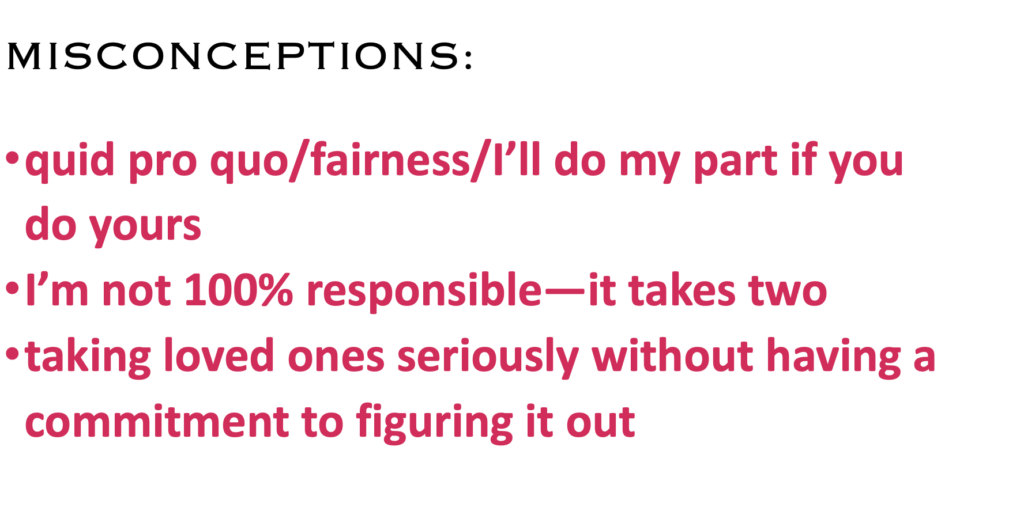
Finally, a misconception that is worth being aware of, because it so profoundly works against problem-solving. All forms of viewing yourself as not responsible disempower you and result in you solving fewer problems than you would otherwise. Quid pro quo thinking, thinking in terms of fairness, weighing up who has done what and who is doing their fair share, or “I’ll do my part if they do theirs”, or “it takes two”—actively work against problem-solving. Such thinking assumes that not all problems are soluble, or that they are only soluble if the other person does their part. Whereas actually, it doesn’t take two, it just takes you! You have a brilliantly creative mind—far more brilliantly creative than you know. And once you see the mistake of such thinking clearly, and how that lack of commitment to figuring it out with your family has been holding you back, that knowledge can be transformative in ways unimaginable to you in the absence of that knowledge.
I myself did not see this misconception clearly until 2018, when I received some incredibly valuable life-altering criticism. I had seen aspects of it long before—I have been criticising quid pro quo thinking and fairness for decades—but what I did not see until 2018 was that having a commitment to figuring it out makes a massive difference not just with your spouse but in all your family relationships. It changes everything. Intractable problems suddenly get solved. All because of a change of heart on your part—the creation of a bit of knowledge. This blew my mind. I had thought that I think problems are soluble. I had thought that I had tried everything to solve one particular intractable problem I was having with a relative of mine not talking to me for many years. Yet the moment I saw that if it were my husband not talking to me there is no way I would not have resolved the problem with him, I saw that my critic was right that I had (as my critic put it) sold out on my relationship with my relative. I had lacked the commitment to figuring it out with my relative that I do have with my husband. And I was responsible. That insight made it effortless to resolve things with my relative, and doing so was transformative for my entire extended family. And when I have told people about this, they themselves have seen the problem-solving power of having a commitment to figuring it out, and they have transformed their own broken relationships in turn.
It is not just about transforming broken relationships. It is not even just about resolving disagreements with loved ones. Having a commitment to figuring it out changes everything in terms of solving problems more generally. It is a stance that has you not just thinking that problems are soluble in a theoretical way that does not always touch your soul as it were, but wholeheartedly being problems are soluble.
Whether with your partner or your children or with other people important to you in your life, having a commitment to figuring it out, relishing owning 100% responsibility for making this relationship/family life amazing for all of us, is fun and interesting and might well astonish you in its power to free up and bring online transformative creativity.
In conclusion…
There will always be misconceptions, because we are fallible and lack knowledge, but discovering and correcting one’s mistakes can be an endless source of interest and fun!
[Criticisms gratefully received, either in the comments below (your comment will not appear but I will see it), or by DMing me on X).]
See also:
Sarah Fitz-Claridge, 2026, ‘Misconceptions about Taking Children Seriously’, https://takingchildrenseriously.com/misconceptions-about-taking-children-seriously