
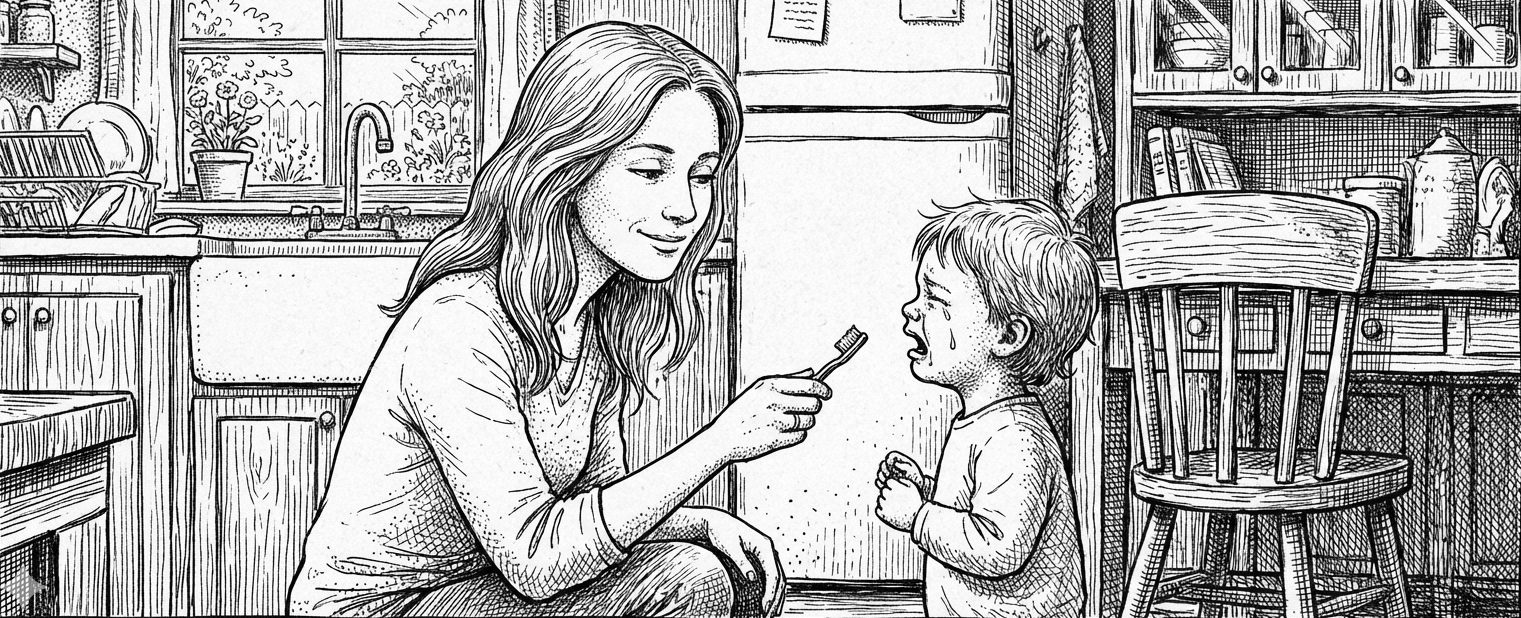
“If we take connection seriously instead of coercing, disagreements can be fascinating and fun opportunities to come up with a brand new idea we all love—one that did not exist at the start of the interaction. That solution is a new connection between us. And it has emerged through us noticing or creating connections between us via our wishes and reasons.”
– Sarah Fitz-Claridge
In their book, Listen: Five simple tools to meet your everyday parenting challenges, Patty Wipfler and Tosha Schore say that “Hand in Hand Parenting is founded on the core observation that parents and children are at their best when they feel close and connected. The troubles that exhaust you and complicate your child’s life can be resolved by focusing on connection!”1
That raises the question: what creates connection—and what breaks it? If I feel very warm towards my child, does that rule out disconnection? What is connection, and how can parents identify and correct disconnection?
Conventional family life, with all its battles for control, is riddled with disconnection. When parents and children are at odds, they stop collaborating and put the walls up. Everyone is defending their corner. They are surviving rather than thriving. Life can feel quite difficult.
In her preface, Patty Wipfler shares a transformative moment from her early days as a parent: someone really listened to her when she desperately needed it, and that enabled her to reconnect with herself and her children. Later, when her two-year-old needed eye drops and she dreaded holding him down kicking and screaming, she remembered that listening. She decided to try listening to her son. Initially, he was frightened and crying, but instead of forcing him, she stayed with him and lovingly listened, until he ended up happily putting the drops in his own eyes. She concluded:
“Parents themselves needed an emotional outlet! And they didn’t have to dominate their children. Children could go from balky to cooperative if a parent would listen. Families could be warmer and closer, as ours had become. … It felt great to parent this way—working with my child’s feelings, rather than against them.”2
Indeed, who wouldn’t bristle at being bulldozed? If you are dominating your children, working against them instead of on their side, they are bound to feel put out, and might not feel terribly cooperative. Most people don’t like it when someone is just not listening to them—not hearing their no. It is all very disconnecting, isn’t it? Whereas when we are listening to reason, curious about our loved ones’ wishes and their reasons for those wishes, and not violating consent, warm connection with them can flow naturally.
When you stay connected instead of dominating, your children have no fear that you might force them, so they do not have to keep their guard up against you, they can relax, turn outward to engage with the world, and move forward fearlessly. As Patty Wipfler and Tosha Schore say: “When she senses you’re on her side, she can learn, cooperate, and connect with others.”3
There are several heartening examples in the book, showing what a difference it can make to desist from the disconnected dominating even just sometimes. Children are so much more gracious than adults!
So far, so good. But it isn’t only connection between people that matters. Disconnection anywhere in the family system—including within an individual mind—interrupts the creative family flow.
When you disconnect from yourself—from your curiosity, from your empathy, from your own moral compass, or from your own wishes—that inner disconnection fractures your connection with others. If you disconnect from your curiosity about your loved ones’ wishes and about their reasons for those wishes, that is an ocean of missing connection between you. If you disconnect from your empathy, you have a wall up disconnecting you from the emotional experience of the other person. If you disconnect from your own moral values, you have a wall up against your moral compass that would normally be urging you not to violate consent. If you disconnect from your own wishes, against your own will, painfully sacrificing them for another, you are hiding your pain behind a mask. Who can connect with a mask?
When there is disconnection anywhere in the family system, problems that could have easily been solved go unsolved. Upsets proliferate. It hurts. Whereas when there is nothing blocking connection, the family flows with creativity, and problems get noticed early and solved collaboratively. Instead of strife and stress, there is affinity and fun.
Patty Wipfler’s original insight that I quoted above, is valuable. Indeed, it is truer than she seems to realise. The view of children presented in Listen: Five simple tools to meet your everyday parenting challenges is the standard paternalistic view: the assumption that, unlike adults, children must be coercively controlled for their own good. Setting Limits is one of the “five simple tools”.
The authors call all five tools the Listening Tools, but when you are setting and enforcing a limit for someone—making them do something they don’t want to do, or preventing them doing something they do want to do—i.e., coercing them—would they agree that you are listening to them? Are they likely to be feeling heard by you? You are not listening to reason—not engaging with their wishes and reasons, not hearing their no. You may think you are listening to their feelings, but you are refusing to be influenced by them. And you have emotionally disconnected yourself from their experience. From their perspective, you are just not listening to them. So the Setting Limits tool would be more accurately called the Not Listening tool.
The underlying assumption of the Setting Limits tool is that coercion is necessary. (The authors do not see it that way, but what they propose would seem coercive to anyone on the receiving end.) So instead of replacing the disconnected dominating with connected listening, the Hand in Hand Parenting project attempts to mitigate the coercion (i.e., what I myself would call coercion) with doses of connection. As the authors put it: “balance the limits you set with regular Special Time”4, or in their more Orwellian terms: “create a balance between your generous yesses and the gift of no.”5 (What a pity they do not seem to welcome the child’s no as a gift too!)
Staying warm while disconnectedly imposing your will is certainly better than imposing your will coldly. But that is still a lot of disconnection!
Are you thinking that it is perfectly possible to be staying fully connected while setting and enforcing limits? Do you disagree that violating consent involves disconnection? If so, then you are imagining connection as being somehow disconnected from everything else, somehow unaffected by things that if you were on the receiving end, you would find disconnecting at least to some degree. It is not that there is zero connection left when you violate consent; but all these little bits of coercion are little bits of disconnection that have adverse effects, leading to further breaks in connection, further adverse effects, and so on. (Otherwise there would be no need for any of the balancing that Patty Wipfler and Tosha Schore keep recommending.) So although of course there will be breaks in connection no matter how well-intentioned everyone is, disconnection anywhere in the family system is worth correcting if we possibly can.
Life can be so much more connected and delightful if you can drop the old paternalistic view of children that keeps you so disconnected from them, and fully embrace connection and listening to them like you do adult loved ones.
And I mean that life can be more delightful for you too, not just for your children. It is exhausting work to maintain your dominant position. It is not simply a matter of issuing an order or setting a limit and then watching them meekly obey. It is endlessly draining and stressful. There is all the resistance to deal with, all that working against your children to compel compliance—endless grinding battles against your own beloved children. As fast as you can deal with one issue, two more appear. As soon as you enforce one limit, that missing connection is creating yet more issues seeming to you to necessitate more intervention, more limits, leading to more anger, more tears. An endless vicious circle of disconnection.
To maintain your dominant stance you must work against parts of yourself that are normally human and decent. You have to work against your own reason—your own rationality—to maintain your fingers-in-the-ears-la-la-la-not-listening stance. You have to disconnect from your normal empathy to avoid being unable to bear the anguish you are causing. You have to disconnect from your moral compass that abhors violating consent. You have to steel yourself against your children’s resentment. Inure yourself to the pain of their anger towards you. Try not to see your betrayal reflected in their eyes. And you have to keep all this out of your awareness.
You cannot even afford to allow yourself the normal curiosity about what your children’s wishes are, and about their (often absolutely fascinating!) reasons for those wishes. Your unconscious mind has to cut you off from their personhood, deluding you into seeing them as being more like a sack of potatoes or a rather obtuse puppy. (And maintaining that parental delusion outside your awareness itself takes work!) So you completely miss the wonder and fascination and joy of deep connection with these new people as they first explore the world. That alone turns life with children into boring, stressful, soul-destroying drudgery.
Instead of seeing the breathtaking creativity and exploration and learning of your child’s genius at work, catching glimpses of their noticing something unexpected, their bold conjectures, their ingenious tests of their conjectures, and so on, parents disconnected from their child’s personhood see an uninteresting, non-rational nuisance requiring a gruelling slog of endless management.
My heart breaks for everyone involved. Life does not have to be like that. None of that disconnection is necessary; none of it is inevitable.
This is not to suggest that anyone knows how to live in perfect connection always, with not a single jot of disconnection causing any trouble anywhere. We are all human. We are all fallible. We all have gaps in awareness. We are not omniscient. Whoever you are, and whatever your intentions, there will be bits of disconnection resulting in something going wrong sometimes.
Sometimes, someone gets upset or angry, and it is often not obvious what caused it. A child (or an adult loved one, or you) might build up frustration as one wish after another goes unmet (quite possibly unnoticed, not intentionally ignored) and then something else happens—the last straw—and the child gets upset or lashes out. Only then does the parent notice the disconnection.
When that happens, most parents look at the child’s outburst, see no reason for it, deem it unacceptable behaviour, and add more disconnected, disconnecting dominating to ‘correct’ the ‘off track’ behaviour.
But if instead of just looking at the outburst itself, you look at what led up to it, you can often see what caused it and correct your inadvertent coercion or otherwise solve the problem. If your first guess is mistaken (as it often is), you keep trying to identify and solve the problem until you do. At least, that is my approach. Problems are soluble, and connection can be created, even when everything has gone wrong and there is a great big break in connection.
Listen: Five simple tools to meet your everyday parenting challenges takes a different approach. “Your child needs and deserves a limit the minute her behavior starts to veer off track.”6
Suppose you have scarcely slept in days because your baby is sick, and you are understandably not your sunniest self. There is some painful inner disconnection there. Would it help if your partner thought that you need and deserve a limit the minute your behaviour “starts to veer off track”? When someone imposes their will on you, does that heal your disconnection, or is it itself disconnecting?
To favour setting a limit and enforcing it when a loved one is upset, you have to disconnect emotionally from the experience of the person on the receiving end. If you find it absurd that I am asking you to think how you would feel if it were you on the receiving end, because you are not a child, then you have disconnected from your empathy. A child is not a different species. There is also disconnection in your values. Values are inherently universal. When your moral compass abhors violating consent, but you make an exception when it comes to children, that incoherence is disconnection from your moral compass. And all this disconnection within you is disconnecting you from your child.
Suppose that, in the midst of an upset, your wife reacts badly when you complain that she has not unloaded the dishwasher. Do you respond lovingly to her ‘off track’ behaviour, or do you set a limit and enforce your will?
What if you’ve made a good connection with your wife but she still won’t cooperate? (Would you want to be married to someone who thought like that?!)
“When you’ve made a good connection and your child still won’t cooperate, Setting Limits and Staylistening7 are the tools that will help you deliver the gift of ‘No.’”7
Imagine being a wife reading this in a marriage guidance book for husbands:
“When you’ve made a good connection and your wife still won’t cooperate, Setting Limits and Staylistening are the tools that will help you deliver the gift of ‘No.’”
You “still won’t cooperate” even after your husband has kindly “made a good connection” with you? How ungrateful!🫣 The ‘gift’ of “No”. From someone who won’t take your own “No” for an answer. Note the chasm of missing connection in that attitude, and in the logic of the argument promoting such disconnection in the name of connection.
The point is not that the authors intend any unkindness towards children. It is that their approach quietly requires parents to disconnect from their ordinary adult standards: ordinary empathy, ordinary horror at consent violations, ordinary reluctance to dominate or bulldoze someone you love. You might argue that the coercion is necessary, children need limits, what if this, what if that, blah blah blah; but surely you would not want to suggest that the one being coerced is mistaken about their own experience of the coercion (as being disconnecting)?
Instead of recommending that we give our children the same grace, patience and respect we ourselves would hope for, the authors recommend that “the minute her behavior starts to veer off track” or “out of whack,”8 we employ the three steps of the Setting Limits tool.
“Step 1. Listen and think. … When your child’s behavior seems out of whack, stop what you are doing, listen, and think. … Once in a while, we parents think our child is off track when he’s not, and listening first gives him the benefit of the doubt.”9
But whose behaviour is out of whack in the following example? The one saying no, or the one not listening? The one expressing a perfectly reasonable wish, or the one trying to hide their disconnected dominating behind Orwellian euphemisms?:
“It was time for my six-year-old son to do his homework. Every time I suggested it, I was met with avoidance, tears and whining. I moved in close and set a gentle limit. ‘You know it’s time to do your homework now,’ I said putting my arm around his waist. ‘No!’ he said, and ran off. I followed him and set the limit gently again. This time, he started to cry… He started to push hard against me, got angry and yelled. ‘You are making me do this!’”10
The child is right: the parent was making him do it. The imperious “it’s time to do your homework now” decree understandably upset him. Instead of cooperating with him or hearing his no, the parent manhandled him to enforce compliance, and calls this limit enforcing “gentle”.
If that was gentle, I’d hate to see not gentle. Talk about disconnected! And the disconnection is not just in the coercion itself. Notice the disconnection implicit in the “I was met with”: parent against child—a wall of disconnection instead of the flow of harmonious connection that is possible when you are not feeling entitled to boss the other person about and requiring them to obey you. Notice the disconnect from the child’s distress.
“Step 2. Bring the limit. There’s no need for harshness. Instead of yelling, issuing an order, or scolding your child for bad behavior, simply put yourself between your child and the nutty thing he’s doing.”11
So often in the book, the child’s behaviour is not nutty at all. In one hypothetical example, a two-year-old child is happily working with his blocks.12 Instead of giving him the courtesy you would give an adult and allowing him to decide for himself when he has reached a natural break in his work, the parent—emotionally disconnected from the child’s experience and from the normal value of consent—physically stops him playing with the blocks and sets a limit (i.e., declares, commands and enforces the command) that it is dinner time and the son must put the blocks away.
The authors calmly concede that this may cause him to “scream or cry.”13
Your child screaming and crying as a result of Step 2 brings us to Step 3:
“Step 3. Listen. This is the crown jewel of the three steps. Once you have brought the limit, listening to your child’s upset will allow him to recover from whatever hurt him.”14
So there you are, disconnected from your normal empathy and your child’s emotional experience and wishes, having brought your child from a happy state to one in which he is distraught. Do the authors suggest a rethink? An apology? Some soul searching? No. They say of your child’s anguished crying and screaming:
“Though the others around you [dinner guests?!] may not understand, the situation has improved.”15
Yes they really did say that. The missing connection is flabbergasting.
And in case some remaining shred of your humanity is screaming that this is a despicable way to treat a child, the authors urge that you “keep holding the limit”—keep the wall of disconnection up, against your child!:
“All you need to do is to keep holding the limit and offering your warmth. When his crying tapers down, you ask again, ‘Son, can you put the blocks away yet?’ He will release feelings until he can reconnect with you and regain his ability to reason.”16
If that is warmth, I’d hate to see coldness.
Offering warmth in no way counteracts the wall of disconnection the parent has erected. It is not the child who is creating the disconnection, it is the parent. And the idea that a child disagreeing with you implies irrationality on their part is a substantive theory. It seems self-evident to the authors. It seems to me self-evidently false. The mere fact that someone does not want to follow your agenda tells you nothing about the quality of their thinking. Parents are fallible human beings too.
The purpose of the Setting Limits Step 3 listening is not about being connected, open and responsive, it is to hold the parent’s decision immune from influence (a wall of disconnection!) until the child has given up resisting. The parent calmly restates the demand and waits the child out. To clear the moral fog, imagine this in a marriage manual for husbands:
“All you need to do is to keep holding the limit and offering your warmth. When her crying tapers down, you ask again, ‘Can you cooperate yet?’ She will release feelings until she can reconnect with you and regain her ability to reason.”
Would it help you to feel listened to if your husband felt entitled to be Setting Limits for you, but he uses the Staylistening tool (staying and listening, which is also Step 3 of the Setting Limits tool) to “pour in [his] quiet confidence that [you will] recover”17 when you are going through the “full-throated drama”18 of the distress occasioned by his coercive control?
But don’t worry. The marriage guidance book also assures husbands that “[it is not that] we want to make our [wife] cry. In fact, we try not to come to our [wives] with an agenda for how they should feel, or how they should release their feelings.”19 You may feel distressed, traumatised, furious or terrified. However you feel, your husband will Staylisten as you ‘release’ your feelings until you comply. And he will just keep on listening without relenting for as long as necessary for you to capitulate, and as often as necessary to show you that resistance is futile. The wall of disconnection is immoveable. I’m feeling the learned helplessness setting in just thinking about it. Whatever must it be like for the child?
Everyone recognises that this attitude is not conducive to a good adult relationship. It is not enough for the coercively controlling party to mean well and to try to palliate the disconnecting dominating with listening to the distressed crying caused by their coercion. Yet somehow, when the other person is a child, all our normal concern for consent, for listening to the other person’s reasons for disagreeing, and for remaining genuinely connected and seeking wholehearted agreement rather than intransigently imposing our will, disappears.
You may be thinking, But they’re not adults, they’re children!
Indeed they are. But have they not interests and concerns, wishes and reasons, preferences and feelings just like we do? Do they not prefer to be consulted about matters affecting them, just like we do? Is their distress or anger or trauma when coerced any less real, painful and important to them than ours is to us? Are their hearts stronger than ours, to bear the agony of being coerced by someone they love, trust and depend on?
If connection matters, surely it matters if the experience of one of the parties is that the other’s attitude and actions have broken the connection between them? Why would that experience only count if the person on the receiving end of the disconnecting attitudes or actions is an adult? Are we listening to the child’s experience or aren’t we?
The authors repeatedly reframe the child’s distress as being about unrelated emotional backlog:
“Your child’s reaction is likely to seem huge, compared to the small request you’re making, but you can assume he’s clearing out tension from other days and other limits.”20
And:
“A good limit, followed by Staylistening, helps her return to playing and functioning well once again. And over time, your child’s backlog of held feelings empties…”21
They urge parents to try to Staylisten all the way through the crying, likening it to “allowing your child to nap till she wakes”22, saying:
“If you can’t listen all the way through, your child will be left with no way to release the rest of the difficult feelings her mind had hauled out for removal.”23
“Crying is the healing process. Diverting a child away from crying… means that an opportunity is lost.”24
“[Y]our child’s feelings are leftovers from some trouble that is long gone.”25
So the intention of the listening that is Step 3 of the Setting Limits tool, is to help the child release long-held stored emotions that just happen to be precipitated by a perfectly innocuous small limit you are setting. And once all that long-held emotion is released, we’re told, the child returns to their right mind, and thus wants to comply.
This may be psychologically appealing to parents because it keeps the parent disconnected from the uncomfortable truth that the child is crying because of the parental coercion in the present. It insulates parents from guilt: my child is not crying because I’m forcing him to put away his blocks, he is crying because of some mysterious past trauma, and I am helping him heal. The theory functions as moral anaesthesia. It is a way of entrenching the missing connection while deluding oneself that one is remaining connected.
Many parents are drawn to this woolly thinking because it uses the language of connection and healing. They look into their hearts, see that they feel warm towards the child, and honestly believe they are connecting. Whilst other parents would shun, silence or punish the child, Hand in Hand parents stay and listen, to help the child heal. Where is the disconnection in that?
The disconnection is from your normal empathy—the empathy that feels how it feels to be the other person being treated that way, the empathy that if it were your beloved adult partner, would tell you that when they are out of sorts, there is an understandable reason for that even if you don’t know what it is, and that either way, the last thing to do to someone who is already out of sorts is to upset them further by imposing your will. And there is the moral disconnect in which consent matters for adults but can be overridden for children. And there is the disconnect from the child’s personhood, from their wishes, and from their reasons for their wishes. Profound disconnection from the child.
You have set a limit. There is no question that your will will be done. You are willing to stay and patiently listen to the child crying until the child complies. No matter how distressed the child is, no matter how much they sob, rage, beg or plead, no matter what arguments they give you, nothing they do or say will move you from your decision. Resistance is futile. Totally out of attunement with your distraught child despite believing yourself to be perfectly attuned. You can wait, with warmth and confidence, for as long as it takes for the child to give up and obey.
No matter how connected and warm you may feel towards me while you are forcing me to do something against my will, I myself am not feeling it! And neither would you if it were you on the receiving end. The gaping chasm of disconnection would be obvious.
If you would not dominate your spouse that way (and judging by the examples, I rather hope you wouldn’t), maybe you should not treat your children that way either. They may be younger than you are, and more dependent on you, but their hearts break just as easily. And unlike a spouse, they can’t walk out the door when you refuse to listen.
Replace the word “child” with “wife” to reconnect your empathy so you can see the disconnection under the Orwellian language:
“[U]nless the house is on fire, give your child the chance to cry hard while she tells you that she’ll never, ever do what is required. Let her carry on until she feels done. Every now and then, calmly restate the next step, and ask her mildly if she’s ready to take it. … ‘The table is cleared. It’s time for homework.’ … Let your child cry hard about the thought of that next step. … Given the time she needs, she’ll be able to comply in the end. Don’t give in. Don’t give up.”26
In terms of the psychological mechanism creating compliance (not otherwise), these ‘listening’ sessions remind me of Maoist struggle sessions. (See Robert Jay Lifton’s Thought Reform and the Psychology of Totalism: The study of brainwashing in China (1961, 1989).) It is not just Step 2 of the Setting Limits tool that is coercive and disconnected. The listening that is Step 3 is itself part of the Setting Limits machinery coercively compelling compliance. You are listening, yes—but not to reason. Not to arguments. Not to the possibility that the child might have a point. The listening functions as a way to hold your decision immune from criticism.
It can be hard to see this because the parent’s intention is good. But the intention does not change the structure. The structure is a struggle session.
To put your child through a struggle session to compel compliance, you have to disconnect yourself emotionally from them so that you can remain calm and at least somewhat anaesthetised to the trauma you are putting them through. You have to delude yourself into reinterpreting the struggle session as staying connected and listening supportively. And you have to delude yourself into reinterpreting the distress you are causing them as healing release of unwanted long-stored feelings.
The authors even quietly acknowledge how hard this is on parents. They describe these Staylistening sessions as “the times that try parents’ souls”27 and emphasise that “it’s OK to stop Staylistening, abruptly if you need to. In fact, it’s vital to stop if you become upset.”28
Why is the adult’s upset an emergency—“Stop Staylistening the minute you feel upset.”29—but the child’s upset is a healing process that must continue to the bitter end “unless the house is on fire”30 no matter how distraught the child is?!
The double standard is breathtaking. If the parent—the adult with all the power—cannot bear even just to witness the child’s upset, how is the defenceless child supposed to endure the upset?
But don’t worry. You will get used to shutting out the extreme distress you are causing your child: “You’ll begin to relax with Staylistening when you’ve become accustomed to the fact that our children pin their deepest feelings on tiny issues.”31 You will feel better once your wall of disconnection more reliably keeps the suffering you are causing your child out of your awareness.
The authors urge parents to get regular support from their adult “Listening Partnerships” to help them cope with the strain of these sessions. They write:
“When your child feels deeply threatened, it sets off the biggest internal alarms a parent has. It takes courage to hold on to the perspective that your child’s feelings are leftovers from some trouble that is long gone. You’ll need listening time regularly…”32
An adult Listening Partner listens without judging, advising or psychologising, and treats the parent’s every thought as important.33 What a pity that last bit is not carried over into the Staylistening for the child…
Why so much need for emotional support if what you are doing is obviously good? Why do parents need to be inuring themselves to what they are doing? Why the ignoring of deafening inner alarm bells? Why does it take courage if there is no doubt about the cause of the distress?
If the advice to you is to stop the moment you feel upset, how much more important must it be to stop the moment your child feels upset? There is a reason your inner voice is crying out against this struggle session. Your inner wisdom is valiantly urging connection instead of domination. Listen to it!
If you still believe that Setting Limits Staylistening is listening to your child in their hour of need so they can heal, I have a question for you. If you follow the authors’ advice to stop listening the moment you feel upset, whatever happened to the idea of being there for your child in their hour of need so they can heal?!
And what is it that is causing all this fear and trauma in the first place if not precisely all the disconnected dominating of the Setting Limits tool and other coercion?
You may be wondering what a parent taking children seriously would do, when facing the “everyday parenting challenges” described in Listen: Five simple tools to meet your everyday parenting challenges. The question is understandable, but the vast majority of the challenges discussed only arise when you are not taking children seriously.34
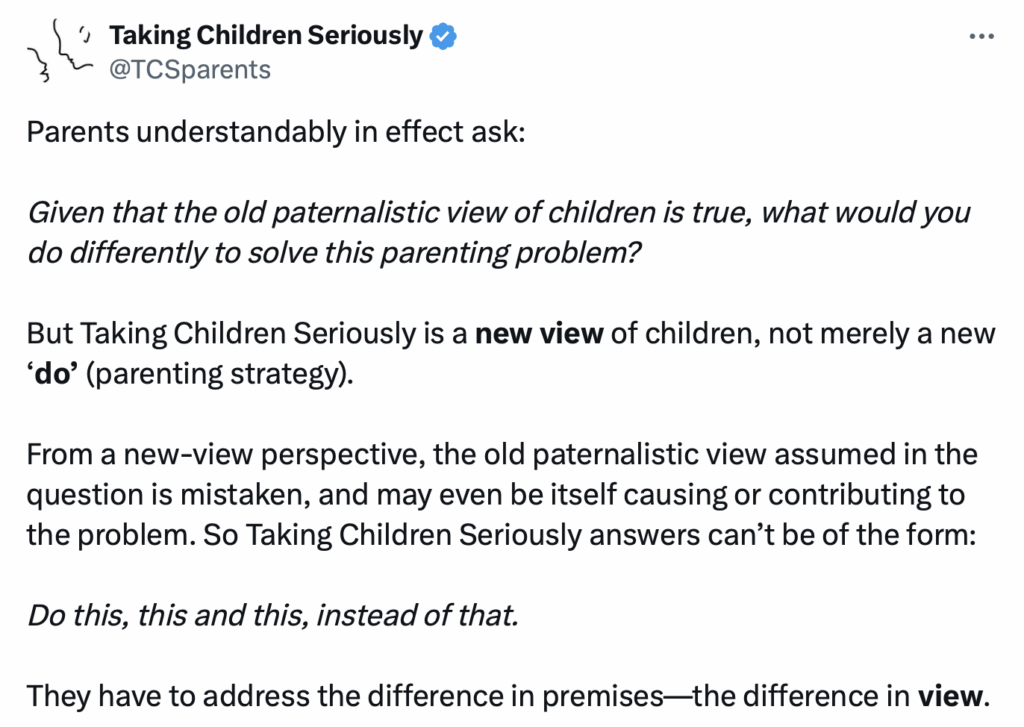
It is in the nature of coercion and the old paternalistic view of children, that one bit of coercion seems to spawn the need for more. And more. And more. The underlying assumption that children need to be coercively controlled is what causes the problems that parents point to as evidence that children need limits.
The tragedy is that none of this is necessary. The “emotional backpack”35—the overflowing store of distress needing regular emptying—is not an inevitable feature of childhood, it is the smoking gun of coercion. The build-up is the predictable result of living under parental domination, of a thousand daily disconnected, disconnecting moments in which the child’s wishes are overridden, indeed not even noticed. If instead we treat children with the same courtesy we extend to our spouse or colleagues—seeking consent, taking their “no” seriously, and finding solutions we all prefer—the backpack stays empty.
Imagine life in a family life in which everyone’s wishes matter, irrespective of age. In which we don’t brush over a tiny hint of disagreement, we don’t ignore a momentary wistful glance, we don’t plough on when a baby’s face says no. In which we cherish our loved ones’ smallest wishes. In which we are curious about, and engage with, their interests, concerns, work, problems, wishes and reasons. In which we address potential problems long before anyone gets upset, angry or fearful. In which we view problems as soluble and actively solve them all the time, not just when there is a conflict or obvious disagreement, but the moment any hint of a problem arises. Indeed, not just when there is a hint of a problem, but all the time, for fun, for connection, for the sheer enthralling wonder of it, because even good situations can be improved. In which we think about what a child might like or not like, and what a child might like even more. And not just a child. Ourselves too. In which wishes are welcome rather than a burden, and disagreements are a delight rather than a disaster.
Problems are inevitable, but problems are soluble too. When family life is flowing with listening and connection and curiosity and creativity, no one is repressing or stuffing feelings, and emotional backpacks are not filling up.
When you view children as full people whose wishes matter just as much as ours do, then when they disagree with you, you do not see yourself as the authority with the final say, and you do not regard it as legitimate to use your power to compel compliance. Aware of your fallibility, you take any hint of disagreement about an issue, even with a child, even about health and safety, to be a sign that there is a problem to solve. Instead of keeping yourself emotionally disconnected from your child so you can dominate them, you stay connected and sensitive to any micro-expression on their face suggesting that they do not agree, and you address and resolve that hint of disagreement such that all parties wholeheartedly agree. When people have gone from disagreeing to agreeing wholeheartedly, there is no longer an obvious problem to solve.
Disagreements in themselves are not disconnecting. If we take connection seriously instead of coercing, work with our children instead of against them, listen to reason instead of not listening to reason, disagreements can be fascinating and fun opportunities to come up with a brand new idea we all love—one that did not exist at the start of the interaction. That new solution is a new connection between us. And it has emerged through us noticing or creating connections between us via our wishes and reasons. Deeply meaningful connections. From each new connection, each new solution we all love, we have more ability to create more connections together, more solutions that make all our hearts sing.
There may of course still occasionally be upsets—we are all human, we all make mistakes, lack sleep, sometimes have something on our mind that stops us noticing a wish that we would usually notice, and so on. But the regime of disconnected, disconnecting domination is absent, so the daily grinding two-hour crying sessions that Listen: Five simple tools to meet your everyday parenting challenges treats as normal simply do not happen.
When a child is upset, we don’t just immediately launch into problem-solving suggestions instead of listening. There are times when someone wants a loved one just to listen. In such cases, the listening itself is facilitating the person’s inner problem-solving, whereas making suggestions would risk interfering with that process.36 But we also don’t view distress as inevitable, problems insoluble, and fatalistically shrug our shoulders as if nothing can be done except crying it out. And we do not treat crying as a magical fluid that is healing in every case. Nor do we use listening as a technique to compel compliance while holding our own decisions immune from criticism.
Patty Wipfler’s original insight that I quoted above—that listening helps, and that parents can work with their children instead of against them, remaining connected with them instead of dominating them—deserves to be taken seriously. Unfortunately, Listen often fails to take that idea seriously. It glosses over the disconnecting domination inherent in Setting Limits, as if a sprinkle of parental warmth mitigates the coercion.
Connection is not a seasoning you can sprinkle onto coercion to make it palatable. The coercion and disconnection is still there no matter how warm you feel. Connection is indeed vital, as Patty Wipfler realised. And we can do so much better than merely ‘balancing’ disconnecting domination with doses of connection.
Perhaps, instead of listening to children cry about what we are doing to them, we might consider not doing it. Perhaps, instead of discounting their experience, we might take it as seriously as we like ours to be taken. Perhaps, instead of holding firm through struggle sessions until resistance collapses, we could stay open and connected long enough to find a connecting solution—one that both the child and we ourselves prefer. Life with children could then be more connected and creative, less disconnected and demoralising. That, surely, is what most parents were hoping for when they started reading this book.
Notes
1. Patty Wipfler, Tosha Schore, 2013, Listen: Five simple tools to meet your everyday parenting challenges, Introduction to Part I: A New Perspective On Parenting, p. 12
2. ibid, Patty’s Preface, p. 7
3. ibid, Chapter 2: Connection is the key, p. 25
4. ibid, Chapter 9: Building Cooperation, p. 151
5. ibid, Chapter 9: Building Cooperation, p. 148. I do not mean to suggest that the authors are aware that they are using a reality-inverting euphemism—that they consciously chose that language to mislead. On the contrary, I think it is more like a gap in awareness, or, to use the term from George Orwell’s Nineteen Eighty-Four, doublethink. Whether they are aware or not (and I assume not), the fact is that when you call something a gift, that you know the recipient is experiencing as actively unwanted and distressing—the opposite of a gift—that is euphemistic reality-hiding language that has come to be known as Orwellian language.
6. ibid, Introduction to Part II: Your Powerful Parenting Toolbox, p. 43
7. ibid, Chapter 9: Building Cooperation, p. 149. Staylistening is another of the five tools. When your child is experiencing intense emotions, you stay and listen, an anchor in your child’s storm, instead of problem-solving, silencing or ignoring.
8. ibid, Chapter 5: Setting Limits, p. 87
9. ibid, Chapter 5: Setting Limits, pp. 86-87
10. ibid, Chapter 9: Building Cooperation, p. 170
11. ibid, Chapter 5: Setting Limits, p. 88
12. ibid, Chapter 9: Building Cooperation, pp. 149-150
13. ibid., Chapter 9: Building Cooperation, p. 150
14. ibid., Chapter 5: Setting Limits, p. 90
15. ibid., Chapter 9: Building Cooperation, p. 150
16. ibid., Chapter 9: Building Cooperation, p. 150
17. ibid., Introduction to Part II: Your Powerful Parenting Toolbox, p. 43
18. ibid., Introduction to Part II: Your Powerful Parenting Toolbox, p. 44
19. ibid., Chapter 11: Lifting Fear, p. 240
20. ibid., Chapter 9: Building Cooperation, p. 150
21. ibid., Chapter 4: Staylistening, p. 64
22. ibid., Chapter 4: Staylistening, p. 67
23. ibid., Chapter 4: Staylistening, p. 68
24. ibid., Chapter 4: Staylistening, p. 72
25. ibid., Chapter 4: Staylistening, p. 80
26. ibid., Chapter 4: Staylistening, p. 71
27. ibid., Chapter 6: Playlistening, p. 109
28. ibid., Chapter 4: Staylistening, p. 68
29. ibid., Chapter 4: Staylistening, p. 69
30. ibid., Chapter 4: Staylistening, p. 71
31. ibid., Chapter 4: Staylistening, p. 69
32. ibid., Chapter 4: Staylistening, pp. 79-80
33. ibid., Introduction to Part II: Your Powerful Parenting Toolbox, p. 44
34. ibid., See “What if…?”
35. Patty Wipfler, Tosha Schore, 2013, Listen: Five simple tools to meet your everyday parenting challenges, Chapter 9: Building Cooperation, p. 179
36. When someone wants you to listen, but you are making suggestions, you are making the rationalist mistake, your explicit suggestions interfering with the creative rational private and largely inexplicit problem-solving of the person wanting you to just listen. (Been there, done that.)
Comments? Criticisms? Questions? To avoid falling foul of the tyrannical new law in Britain, we can no longer have open discussion on the site. If you comment below, your comment will not appear on the site, but we will see it, and it would be lovely to hear from you.
See also:
- Sarah Fitz-Claridge: Taking Children Seriously and freedom (video|audio interview)
- Welcome to Taking Children Seriously
- Children are not irrational
Sarah Fitz-Claridge, 2026, ‘Listen, by Patty Wipfler: the missing connection’, https://takingchildrenseriously.com/listen-by-patty-wipfler-the-missing-connection