
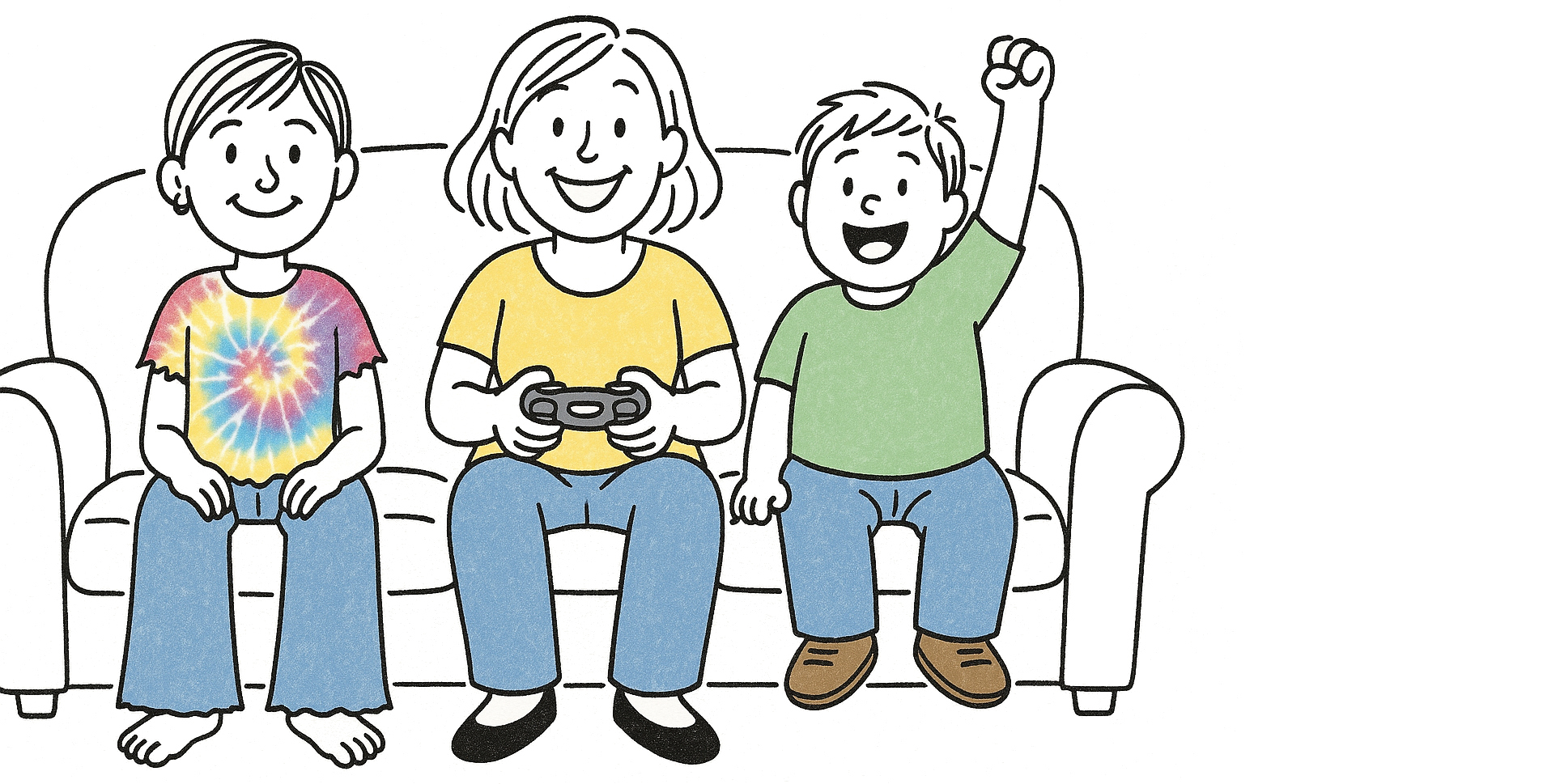
“That’s the thing about taking ourselves and each other seriously: everyone gets what they want, and enjoying your loved one’s joy is just more icing on the cake!”
– Francine Lucidon
Whether because of school culture or general “socialization,” there seems to be a natural desire to “fit in” with one’s community, or one’s understanding of what the community requires. These norms control all facets of our lives, and color our judgement regarding behavior both in social interaction, as well as beliefs, family life, relationships. I had already broken some social norms when, given the early death of my first husband, I didn’t have my first child until I was 38. While that’s not unusual today, 35 years ago I was very much considered an “elderly primigravida.” Two years later I had my second child at the age of 40. So perhaps I had greater confidence as a parent when my children were born. I said hogwash when the helper we’d hired initially said the baby must sleep alone, be left to cry and mustn’t nurse so often. I trusted my baby, I trusted myself, and I read everything I could find on the emerging internet! Soon the helper was downgraded to an expensive laundress and sent away on an early dismissal.
Things were lovely for the next several years. I’d self identified as a parenting “rebel”—extended breastfeeding, family bed, attachment parenting and hopefully homeschooling. Mothering delighted me and I adored hanging out with my two wonderful kids. All was not paradise, however, as we found that my first child was having some difficulty with noise and was prone to great upset in a number of situations. These days, he would be labelled neurodivergent, but back then, doctors barely whispered the word “autism.” His nursery school recommended an “evaluation”—quite different, I am sure, from today’s assessments, which I’ve heard specify degrees and levels of disability. We had never considered our son to be disabled in any way, especially since, in a number of areas, he was extremely “abled.” This was just who he was.
We agreed with his nursery school that it might be helpful to enroll him in a small “therapeutic” playgroup, though I hated calling it that. So we began attending, every Saturday morning. The group was a mix of children, all about his age, roughly ages three to five. Parents sat in one room with a “facilitator,” while the children played in the next room, with a couple of very nice therapists. The parents were expected to talk all about their children, not something I felt very comfortable doing. I listened to stories of a boy who screamed profanities, a girl who had been molested, and another child who was extremely aggressive. In comparison, our child getting upset that the block tower fell over hardly seemed in the same league. One of the boys was being treated by being brushed all over, something I could only imagine my boy and I giggling through the entire procedure. There were many, many technical terms and diagnosis being tossed about for the children. Finally, explaining our “Saturday Class” to my sister, who herself had recently had some fairly serious mental health issues, she asked what suddenly seemed a very logical question. “Okay, let me get this straight,” she began. “You pay $200 a week to bring your son to a playgroup filled with cursing, aggressive, molested children, and I’m the crazy one in the family?” At that point, I decided, instead of getting some authority to tell us what to call our adored child, we were just going to call him by his name. And that was the end of that.
The next couple of years had their ups and downs though most of our puzzlement was behind us. Our son was simply a unique one of a kind being, as was everyone. Our job was to help him have the life he wanted, an idea that became more and more comfortable as I carefully read every post on the Taking Children Seriously mailing list, as well as the profound and complex critical responses. A dear friend who had introduced me to the list would make me laugh when I would question some quirky behavior that seemed entirely unique to our family. She would ask, in all earnestness, “so what’s wrong with that?” and I’d have to peel away several layers of accumulated societal demands and expectations before I could begin to think clearly and critically.
Suddenly I found myself floating free of society, free of expectations and free of any of the unquestioned “rules” I’d always lived with. It felt a little like peeling an onion, although instead of bringing on tears, it just led to more questions and more detachment. It was both thrilling and frightening. We sought out common preferences, helped each other do what we wanted, even if that meant spending the day in PJ’s or watching TV until we fell asleep. Was this a good idea? I wasn’t sure as I imagined neighbors catching a glimpse of us and thinking “hmmm, is THAT homeschooling?” This of course after they’d gotten their clean children with good haircuts and properly brushed and braced teeth, out the door to catch an 8am school bus, each struggling under the weight of an immense backpack. I began to feel a bit rudderless or at least quite lonely.
I tried finding friends in a group of unschoolers that met monthly at a local Quaker meeting house and playground. My children mostly preferred playing with each other, making up games with a set of encyclopedias they found in the kids’ room. I could have sat with the other homeschooling mothers but my children wanted me to participate in their games. Plus the topic of conversation was pretty limited to their kids, nutrition and treating illness with herbs and vitamins, none of which held any interest for me at the time. Also, even among the unschoolers there was a pretty rigid set of expectations to uphold. I remember hosting a meeting at my house and the mothers were horrified that their children had discovered the popsicles in our freezer with artificial coloring! The kids of course were thrilled, though I knew, by their mothers’ reactions, we’d have no more meetings at our house. Even the “out of the mainstream” unschoolers had a set of rules and expectations and made sure their kids towed the line.
As the days rolled on I began to feel more and more isolated. Our children were always happy to go to the library, play a game online, or visit a museum in the city … we even planned some upcoming trips together, but nothing seemed to shake my feelings of loneliness as the days moved along. I knew how to help my children engage with what they wanted, but I was coming to realize, once I’d shrugged off the countless “shoulds” I’d been living with for a lifetime, I really had no idea what I might actually want. As I began to spiral down into a dark place of inertia, I imagined my husband coming home after work one evening to find me lying on the kitchen floor, in my own excrement. Thankfully for all of us, I never quite reached that point.
Then, one Saturday, we decided to visit The Museum of the Moving Image, a family favorite. It’s an absolutely wonderful museum that celebrates the creative and technical process of film, TV and digital entertainment. This particular weekend they had a special exhibit on video games. Like most of their exhibits, this was very “hands on.” It was almost time to wrap up our visit (i.e., hit the gift shop) when I noticed a pair of young boys deeply engaged in a game. The room was softly lit but the bright colors of the game bounced off the surroundings. The music was a delightful combination of Pop and Hip-hop. The boys stared intently at the colorful screen while they rapidly hit the buttons and danced. It was magical. I couldn’t take my eyes off them as I felt myself infused with their focused joy. I wanted that feeling, that immersion into my own happiness … I wanted to Take Myself Seriously! This new mandate, as with taking my children seriously, involved an unquestioning trust in my own desire and a need to explore more deeply.
I looked up the video as soon as we got home. J.C. Herz, a New York Times columnist at the time, raved about the game, “It is a game about hip-hop starring a cartoon puppy dog, the eponymous hero. PaRappa wears baggy jeans and a stocking cap. He raps in English. His world is spangled with elements of hip-hop culture. … And rap, which left our shores as a glorification of the gangsta high life, has returned as something distinctly Japanese: something shiny and round and saturated with color.” She went on to praise its “Japanese earnestness” and concluded that it’s great fun “in any culture.”
I had to have it, and went out the very next day to get a copy. Nothing had made me this happy in months and I had absolutely no idea why. Nor did I need to analyze it. My depression seemed to lift effortlessly. Perhaps it was the “shiny, round, saturated with color” atmosphere, or that happy beat of the music and the chance to improvise and move to the engaging tunes and all of it in a wacky setting (just thinking of it sets my foot tapping!). Or maybe it was the realization that wanting what you want is a good thing, and worth pursuing, judgement free.
I spent the next several weeks playing it—both with my kids and alone. Sometimes they played along but they mostly enjoyed watching me play. I think they really liked seeing me so joyfully engaged. That’s the thing about taking ourselves and each other seriously: everyone gets what they want, and enjoying your loved one’s joy is just more icing on the cake!
If you’re interested, here is my favorite scene, when PaRappa takes his driving test with Officer Mooselini. Even now, these many years later, I can feel my heart lift on those first several notes!
See also:
- None of my business?
- Neighbors reacting to naked kids
- Misery-free treatment of a child’s lice infestation
Francine Lucidon, 2025, ‘My Taking Children (and myself!) Seriously story’, https://takingchildrenseriously.com/my-taking-children-and-myself-seriously-story