
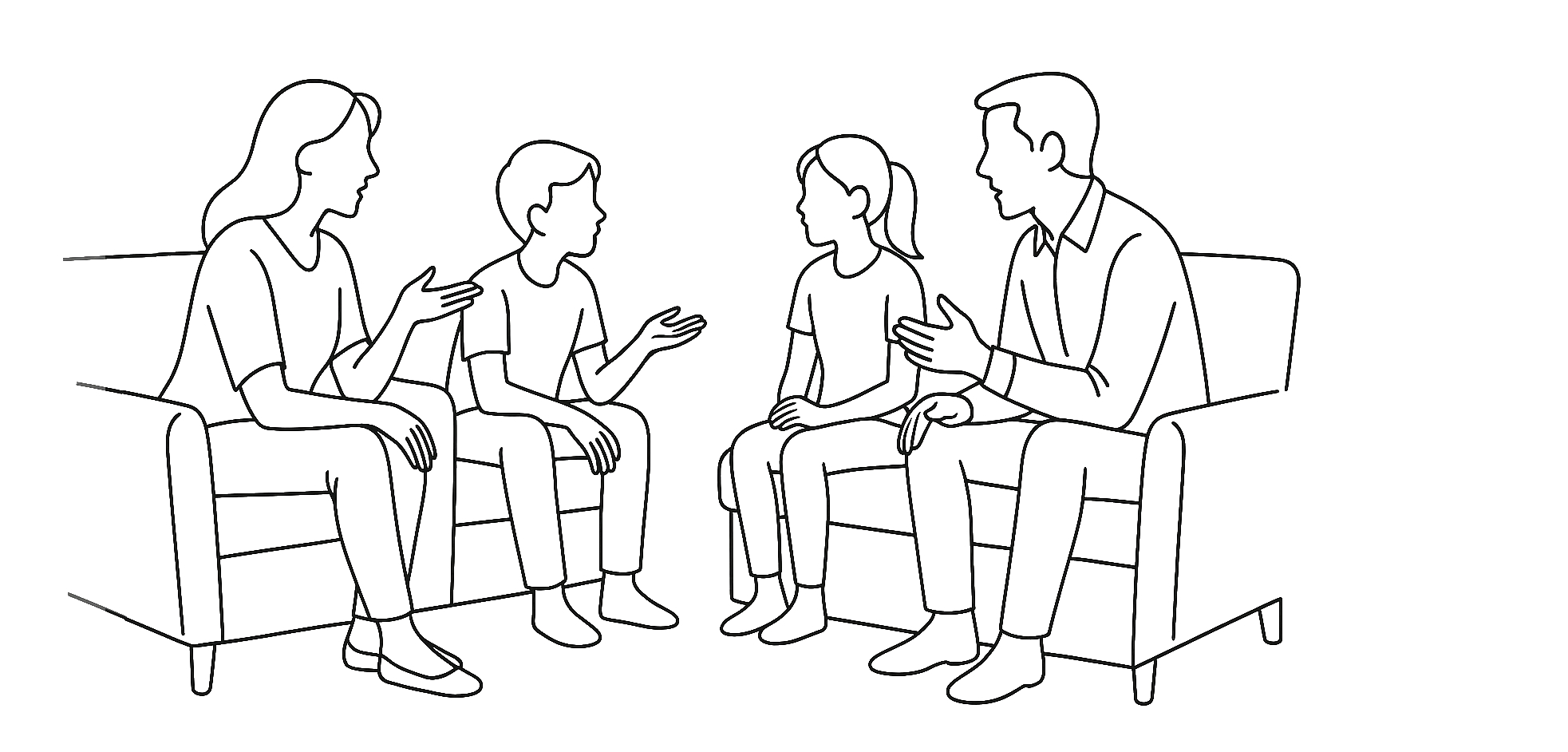
“Family discussions can be so interesting and fun when there is creative rational openness to criticism.”
– Sarah Fitz-Claridge
From the archives: Posted on 9th December, 1994
There seems to be a lot of confusion about some of the things I have said, so this is an attempt to clarify that. I shall be attempting to put some of these ideas into a form that would be clear to a complete layman, so any and all your puzzlements, areas of confusion, misunderstandings, and criticisms would be most welcome and useful.
“[T]he growth of knowledge proceeds from old problems to new problems, by means of conjectures and refutations.”
– Karl Popper, Objective Knowledge, p. 258
As David Deutsch first saw, this idea applies as much to the growth of children’s knowledge as it does to the growth of scientific knowledge; it applies as much to problems quantum physicists are wrestling with as it does to simple disagreements within families. It applies as much to evolution as it does to British political evolution, or the evolution of our societies’ ideas about morality. This is a deep theory relating to all types of knowledge growth or problem-solving. The young child learning to speak may not consciously be making conjectures and eliminating errors, but he is following this same pattern—his behaviour and learning does embody conjectures and refutations—just as less deep scientific theories such as Newton’s are replaced by theories having deeper explanatory power, such as Einstein’s.
“Thus we begin with a vague starting-point, and we build on insecure foundations. But we can make progress: we sometimes can, after some criticism, see that we have been wrong: we can learn from our mistakes, from realising that we have made a mistake.”
– Karl Popper, Objective Knowledge, p. 34
“My first thesis is thus that our starting-point is common sense, and that our great instrument for progress is criticism.”
– Karl Popper, Objective Knowledge, p. 34
“This is all that is needed: as soon as we have competing theories, there is plenty of scope for critical, rational, discussion: we explore the consequences […] which we think may be mistaken. This kind of critical or rational discussion may sometimes lead to a clear defeat of one of the theories; more often it only helps to bring out the weaknesses of both, and thus challenges us to produce some further theory.”
– Karl Popper, Objective Knowledge, p. 35
In the growth of knowledge (or “learning”, if you prefer), the criteria that seem to be important (and they are all intimately related as you can see) are as follows:
- truth-seeking (seeking new solutions to problems/disagreements)
- openness to criticism (if you are not open to criticism, that means you think you already have the truth, and if you think that, you won’t be open to other ideas, because you’ll (mistakenly think you) ‘know’ that they are ‘wrong’—so openness to criticism means taking into account all ideas on the table)
- judging theories by their content, not by their source (this means that in any disagreement or for any problem within a rational knowledge-acquiring entity such as a scientific community or a family or whatever, one is considering the ideas themselves, and not, for instance, thinking, “Hmmm, this idea came from a four-year-old, so it must be wrong,” or “So-and-so is a doctor: he knows best what you should do, little Johnny, so stop crying and let him get on with it”)
- the avoidance of dogma (which is by its very nature entrenched, and not open to criticism)
- the assumption that one may be wrong in anything one says (“we are fallible, and prone to error; but we can learn from our mistakes” (- Karl Popper, Objective Knowledge, p. 265)—because if, in a disagreement, one thinks one is right, that the truth is manifest to any rational person, then one is not going to be seeking the truth, or listening to the ideas of the others involved; rather, one is going to be trying to make the others see the ‘truth’ as we see it, and one is going to be blind to any better ideas that do come up)
- the assumption that the truth is not obvious but is hard to come by (as Popper said: “[T]he simple truth is that truth is often hard to come by, and…once found it may easily be lost again.” (- Karl Popper, Conjectures and Refutations, p. 8) and “The theory that truth is manifest—that it is there for everyone to see, if only he wants to see it—this theory is the basis of almost every kind of fanaticism. For only the most depraved wickedness can refuse to see the manifest truth; for only those who have reason to fear truth conspire to suppress it.” (Conjectures and Refutations, p. 8)—parents who think the truth is manifest tend to see their children as bad/naughty when the children disagree with them)
- but that the truth can be approached (Popper, for many years, did not mention objective truth in any of his arguments because he wanted to make the point that his arguments were independent of whether one believes in objective truth or not, but still, I think it all makes more sense if one does).
Thought you might like this quote:
“As it happens with our children, so it does with our theories: they tend to become largely independent of their parents. And as it may happen with our children, so with our theories: we may gain from them a greater amount of knowledge than we originally imparted to them.”
– Karl Popper, 1972, 1979, Objective Knowledge, Revised edition, Chapter 3: Epistemology without a knowing subject, p. 148
Note (2025): Posts like this one led to the unfortunate misunderstanding that it is possible simply to correct any lack of openness to criticism etc by a mere act of will, as if people have full and direct access to their whole mind, and have perfect knowledge of where they are not open to criticism. Even if you do correctly guess that there is a block in your thinking in a particular area (perhaps because whenever you try to think in that area, it hurts), it does not follow that dropping it will be easy. The mind has a mind of its own, as it were. But still, sometimes knowing about this stuff does inspire positive changes of heart and openness to criticism where before the person’s mind had a block. And the less blocked family members’ thinking is, the more delightful family life is for all. Family discussions can be so interesting and fun when there is creative rational openness to criticism.
See also:
- The final prejudice
- “Surely criticism is always good?”
- A discussion about whether problems are solvable
Sarah Fitz-Claridge, 1994, ‘Rationality in Popperian epistemology’, https://takingchildrenseriously.com/rationality-in-popperian-epistemology