
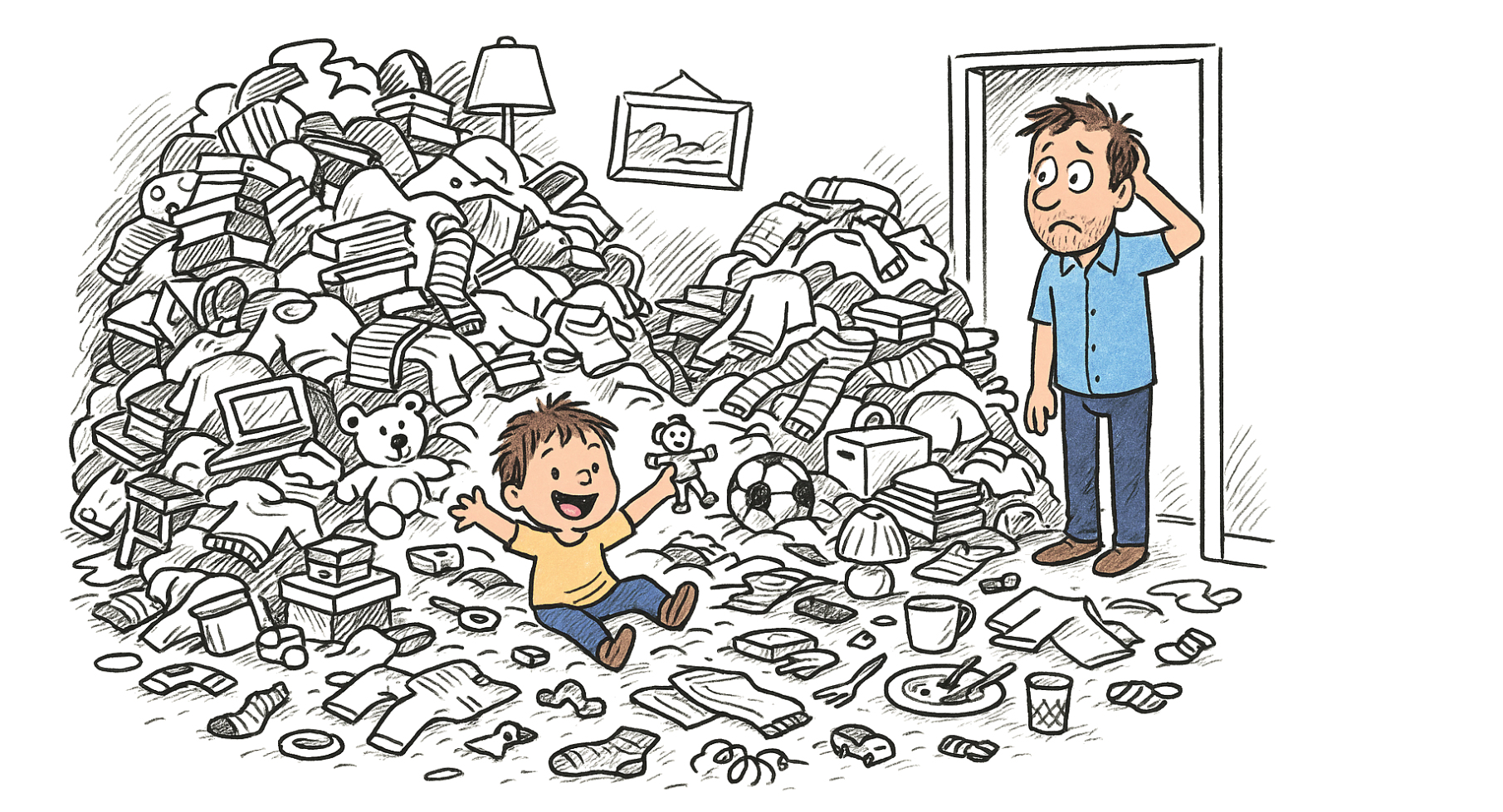
“Every mess is a different problem. Better solutions come if you take each problem as it comes and work out a solution for that particular instance.”
– Christine PK
From the archives: Posted on 2nd January, 2003
“Please explain why it isn’t always morally right for a person who makes a mess to clean it up? Is it morally right for a person to clean up a mess someone else makes and what if no one wants to clean up a mess does it just stay where it is?”
This is one of those questions I ask myself often. Here are my thoughts.
A mess is a problem. There are several ways to solve any given problem. To set up a rule where a certain type of problem will always be solved a certain way is limiting. Every mess is a different problem. Better solutions come if you take each problem as it comes and work out a solution for that particular instance.
It seems simpler to have a set of stock rules. It seems like reinventing the wheel every time there is a mess (or other recurring problem), but it really isn’t. By actually solving each problem, rather than rely on a stock rule that makes sense in the abstract, but doesn’t actually work, I am growing knowledge myself.
A mess is not an objective problem–that is, what looks like a mess to me might be someone else’s project, might be someone else’s unfinished task or might be (to everyone) a mess. It is worthwhile to find out what the other people in the house want to do with the “mess.” My agenda is not necessarily the best one for everyone.
I used to despise people in grad school who were incessantly spouting “it’s more complex than that,” but it really is. Is it morally right for a person to clean up after herself? Yes, in many situations. Is it morally right for a person to force another person to clean up after herself? No, not in most situations.
See also:
- Listen, by Patty Wipfler: the missing connection
- What sort of conflict is coercion? (Was: Bait for Sarah)
- “What if they bring home objectionable literature?!”
Christine PK, 2003, ‘A mess as a problem’, https://takingchildrenseriously.com/a-mess-as-a-problem